
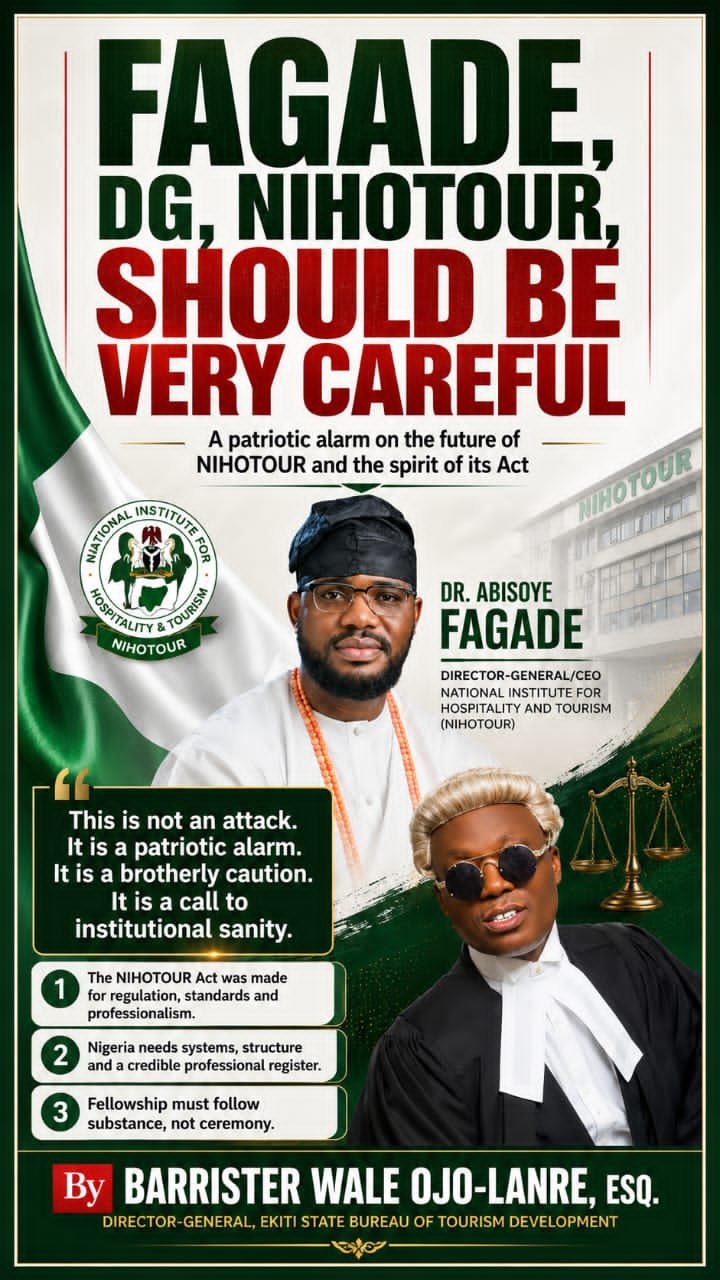
I am not putting this intervention in the public domain merely because I am the Director-General of the Ekiti State Bureau of Tourism Development. I am not writing because I am a Barrister-at-Law and Solicitor of the Supreme Court of the Federal Republic of Nigeria. I am writing because of my deep passion for the proper development, regulation and repositioning of tourism in Nigeria. I am also writing out of sincere respect and affection for the Director-General of NIHOTOUR, Aare Abisoye Fagade, a man whose youthfulness, energy and capacity, I strongly believe, can add immense value to the agency if properly channelled. More importantly, I am compelled to speak because I was involved in the process that led to the construction and drafting of the NIHOTOUR Act, and I understand the spirit, purpose and national expectation behind that law. Therefore, I cannot stand akimbo and watch NIHOTOUR drift from the noble vision for which it was legally empowered.


My intervention is not an attack. It is a patriotic alarm. It is a brotherly caution. It is a call to institutional sanity.
There is no doubt that the National Institute for Hospitality and Tourism, NIHOTOUR, occupies a strategic place in Nigeria’s tourism and hospitality ecosystem. With the coming of the NIHOTOUR Establishment Act 2022, the Institute is no longer expected to operate as a mere training centre, a certificate-issuing office or an event-organising agency. It now carries a heavier national burden: to train, certify, register, regulate and professionalise personnel and practitioners within the hospitality, travel and tourism sector.
That is why the public invitation recently issued by NIHOTOUR for its “Maiden Induction Ceremony 2026 for Certified Hospitality, Travel and Tourism Professionals” deserves fair but serious interrogation.
The theme of the event, “Professional Regulation as a Catalyst for Service Excellence and National Development,” is beautiful. The unveiling of a National Registration Portal is commendable. The inauguration of a Sector Skill Council may also be useful if properly structured, inclusive and industry-driven. But the planned conferment of Fellowship Awards raises a fundamental question: fellowship of what, for what, by what standard, and upon which existing professional structure?
This is not to ridicule NIHOTOUR. Far from it. I strongly believe in the capacity of the current Director-General, Aare Abisoye Fagade, a young, vibrant and energetic leader, to bring a new order to the Institute. In fact, that is the very reason some of us expect more from NIHOTOUR under his watch. A young DG with vision should not allow the agency to be distracted by ceremonial inanities when the tourism sector is begging for structure, discipline, data, enforcement, curriculum reform, industry mapping, professional ethics and national skills development.
The NIHOTOUR Act was not conceived as an instrument for title sharing. It was not constructed to create another platform for plaques, robes, fellowships and ornamental honours. It was meant to empower the Institute to bring order, dignity, competence and measurable standards into Nigeria’s hospitality, travel and tourism professions.
Therefore, the first major public expression of this new legal authority should have been a bold national programme of sector reform, not the premature distribution of fellowships. Nigeria wants to see a credible national register of practitioners. Nigeria wants to see harmonised training standards. Nigeria wants to know how NIHOTOUR will relate with universities, polytechnics, monotechnics, hospitality schools, tour operators, hotel workers, travel consultants, chefs, event managers, destination managers and state tourism agencies. Nigeria wants to see enforcement guidelines, industry classification, professional codes, examination structures and pathways for career progression.
A fellowship is not a souvenir. It is not a decorative title. It is not a political garland. In any serious professional body, fellowship is usually the highest mark of professional distinction, earned after years of practice, contribution, scholarship, leadership, ethical conduct and peer recognition. It should emerge from a mature professional ecosystem, not precede it.
If there is no visible, tested, widely accepted and nationally respected professional ladder yet, what exactly is the fellowship sitting on? If the registration system is just being unveiled, who has passed through the system long enough to merit fellowship? If the national register is still at infancy, what database produced the fellows? If industry compliance is still weak, what professional community has been sufficiently disciplined to produce its highest rank?
These are not hostile questions. They are necessary questions.
The greater danger is that NIHOTOUR may unintentionally reduce a serious national mandate to the familiar Nigerian culture of title-sharing. We have enough fellows, ambassadors, patrons, grand patrons, icons, legends and awardees in the tourism space. What we lack is order. What we lack is enforceable standards. What we lack is a reliable database. What we lack is a national tourism manpower audit. What we lack is service discipline. What we lack is a bridge between training and employability. What we lack is professional dignity backed by law and competence.
That is why Aare Fagade must be very careful.
His leadership should be remembered for building NIHOTOUR into a respected national institution, not for presiding over another round of certificates, plaques and titles. He has the energy. He has the public goodwill. He has the youthfulness. He has the opportunity. But he must resist the old temptation of Nigerian public agencies: launching ceremonies before building systems.
The National Registration Portal, if properly deployed, can be revolutionary. It can give Nigeria, perhaps for the first time, a credible database of hospitality, travel and tourism personnel. It can identify skill gaps. It can support planning. It can assist states. It can help investors. It can separate trained personnel from pretenders. It can professionalise the sector. But that portal must not become another online form for collecting fees and printing certificates.
The Sector Skill Council, too, must not be a gathering of friends, loyalists and Abuja insiders. It must include real operators, hoteliers, tour operators, travel professionals, tourism educators, state tourism boards, private sector leaders, labour representatives and credible practitioners from across the federation. It must be national in spread, professional in character and practical in output.
NIHOTOUR must also clarify its relationship with other tourism institutions, particularly the Nigerian Tourism Development Authority, state tourism boards and existing professional associations. The tourism sector is already suffering from overlapping mandates, institutional ego and regulatory confusion. NIHOTOUR should not add another layer of uncertainty. It should become a centre of order.
So, let the induction ceremony hold. Let the registration portal be unveiled. Let the Skill Council be inaugurated. But let NIHOTOUR pause on fellowship awards until it has built the professional architecture that can justify such honour.
Nigeria does not need another title factory.
Nigeria needs a tourism and hospitality manpower revolution.
NIHOTOUR must think nation, not ceremony. It must think structure, not applause. It must think reform, not decoration. It must think future, not fellowship.
And Aare Abisoye Fagade, in whom many of us still repose confidence, must rise above the ordinary. He should give NIHOTOUR a nationalistic vision, a regulatory soul and a professional backbone.
That is the new order the industry expects from him.
That is the NIHOTOUR Nigeria deserves.
No pun intended.
God heal Nigeria Tourism Sector
….
#NIHOTOUR
#tourism
#tour