

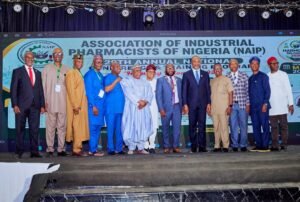
Former Minister of Aviation and Chancellor of the Athena Centre for Policy and Leadership, Osita Chidoka, has urged Nigerian pharmaceutical manufacturers to abandon what he described as an “alibi culture” of excuses and embrace Strategic Quality Excellence to achieve global competitiveness and strengthen the nation’s health security.


Chidoka made the call while delivering a keynote address at the 29th Yearly National Conference and Training of the Association of Industrial Pharmacists of Nigeria (NAIP) held in Ilorin, where industry leaders, regulators, policymakers, and stakeholders gathered to discuss the future of Nigeria’s pharmaceutical manufacturing sector.

He warned that Nigeria is at a critical point and must urgently define the kind of governance structure capable of sustaining national health security and industrial growth across successive administrations.
Highlighting the economic burden on Nigerians, Chidoka cited the rising cost of basic healthcare products and supplements. According to him, four commonly used items — Creatine, Magnesium Glycinate, Vicks Sinex, and a pain relief ointment — currently cost about ₦130,520 in Nigeria.
Although the international market value of the products is about $88, compared to $54 in the United States and $37 in South Africa, he noted that the real concern is the declining purchasing power of Nigerians.
He explained that while workers in developed economies may spend only a small fraction of their income on such products, Nigerian minimum wage earners could spend up to 15 percent of their monthly income — or even nearly two months’ salary — to afford the same items.
Chidoka attributed the crisis to deeper structural weaknesses, especially the pharmaceutical industry’s heavy dependence on imported Active Pharmaceutical Ingredients (APIs), estimated at between 70 and 80 percent.
He stressed that the industry must undergo both psychological and operational reforms by adopting what he called an “Agency Culture,” where manufacturers take full responsibility for outcomes despite economic, regulatory, or infrastructural challenges.
According to him, companies must strategically adapt to changing market realities, technological advancement, evolving customer expectations, and emerging opportunities under the African Continental Free Trade Area.
“The future will not reward those who merely work harder in the same direction,” Chidoka said. “It will reward those who are willing to work differently with a long-term vision.”
He further argued that regulatory compliance should no longer be treated as a burden, but rather as a strategic opportunity to improve quality, efficiency, and global market confidence.
Chidoka challenged manufacturers to move beyond the minimum requirements set by National Agency for Food and Drug Administration and Control and build systems capable of meeting standards established by the World Health Organization and the United States Food and Drug Administration.
“The regulator’s weakness is not your permission to be weak,” he declared. “You are not building for NAFDAC alone; you are building for WHO, AfCFTA, and the Nigerian consumer.”
He also urged industry players to take the lead in reform efforts by prioritizing innovation, accountability, data-driven systems, and self-regulation instead of waiting for regulators to act.
Supporting the call for transformation, NAIP National Chairman, Bankole Ezebuilo, emphasized that pharmaceutical excellence must extend beyond mere compliance.
Ezebuilo encouraged manufacturers to take full ownership of quality assurance and institutional performance, noting that excellence should become an internal organizational culture rather than an externally imposed obligation.
He also advocated the use of modern performance management tools such as Key Performance Indicators (KPIs), benchmarking systems, balanced scorecards, and continuous feedback mechanisms to drive sustainable growth in the sector.
The conference also featured internationally respected pharmaceutical executive Henrietta N. Ukwu, who travelled from the United States to participate as keynote speaker and trainer, further underscoring the conference’s global outlook and commitment to international best practices.
Among dignitaries at the event were former Presidents of the Pharmaceutical Society of Nigeria, including Mohammed Yaro Budah, Azubike Okwor, Olumide Akintayo, Ahmed Iyakassai, and Sam Ohuabunwa.
Also present were the current PSN President, Ayuba Tanko Ibrahim, represented by Gafar Lanre Madehin; Registrar of the Pharmacists Council of Nigeria, Ibrahim Babashehu Ahmed; alongside several industry experts and stakeholders.
The Kwara State Government also demonstrated support for the sector through the attendance of top officials, including Commissioner for Finance, Hauwa Nuru; Commissioner for Social Welfare, Mariam Nana Fatima Imam; Commissioner for Communication, Bolanle Olukoju; and Executive Secretary of the Hospital Management Board, Abdulraheem Abdulmalik.
As part of his reform proposals, Chidoka advocated the adoption of “Mekaria,” an African operational philosophy focused on continuous improvement and backed by his M²I framework — Measure, Monitor, and Improve.
He maintained that accountability and excellence must be institutionalized at every level if Nigeria hopes to emerge as a leading pharmaceutical manufacturing hub in Africa.
In his concluding remarks, Chidoka urged pharmaceutical manufacturers to view quality not as a compliance cost but as a strategic advantage capable of positioning Nigerian firms for global contract manufacturing opportunities and leadership within the AfCFTA market.
He added that the burden of expensive medicines affects manufacturers, regulators, and consumers alike, stressing that addressing the industry’s deep institutional weaknesses is essential for Nigeria’s healthcare future and economic resilience.