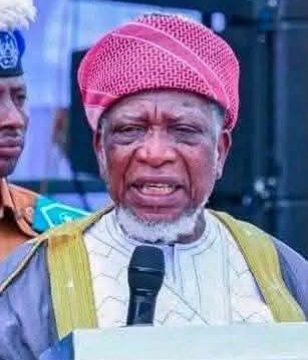
Sheikh Sani Yahaya Jingir is supposed to be a cleric whose duty is to shepherd people onto a godly path. That is the calling he took upon himself. On 8 August, however, he caused many Nigerians to question his conduct when he trod a path that would have made Fela Anikulapo-Kuti exclaim: “Teacher, don’t teach me nonsense!”


The sheikh would indeed need to listen to Fela’s 1986 song titled “Teacher Don’t Teach Me Nonsense,” one of his classic Afrobeats protest songs against societal ills. While the music was not directly about the physical teacher, it was about the authorities of the time and their offerings in the Structural Adjustment Programme (SAP) and all the perseverance, discipline, and austerity the government of the day was preaching, as they continued to urge the people to keep suffering and smiling. To Fela, it was pure hypocrisy, since the government people were doing the exact opposite of what they preached.

In his recent public outings, Sheikh Jingir crossed the line expected of religious leaders as he reeled out some unwanted injunctions. The Yoruba say that an elder should not be in the market while a child is strapped awkwardly on the mother’s back. They also say that where wisdom is expected, foolishness should not reign. Conversely, though, these sayings are challenged by the contemporary view that an elder earns the title only by displaying the wisdom of King Solomon.
Despite the high religious office he holds, Sheikh Jingir appeared to abandon his calling when, in defence of the All Progressives Congress (APC’s) Muslim-Muslim ticket, he claimed that Nigeria is a Muslim country and that anyone who disagrees should leave the country. Jingir is an Islamic cleric and teacher, and National Chairman of the Council of Ulama Jama’atu Izalatul Bid’ah Wa Iqamatis Sunnah (JIBWIS), headquartered in Jos, Plateau State. His hateful religious remarks are especially striking not only because of his position, but because he operates from Jos—a city where he does not need to strain his neck to see the next church. Something is wrong when a man who lives among Christians publicly declares that Nigeria is a Muslim country. He is either living in denial, deluded, or engaging in hate speech.
What these statements have taught us is that, as parents and guardians, we may have left our children vulnerable to the wrong teachers for too long by leaving them in the custody of some religious teachers. In parts of the North, some husbands even release their wives to attend religious teachings in the evenings. Rather than teaching morals in accordance with the holy books, it is fast becoming obvious that such instructors may have been preaching hatred and sowing division.
In today’s world, the link between politics and religion is faint. Religion is personal: how I choose to worship the God I believe in is my business. Politics, by contrast, is a mass project that requires the endorsement of the majority. Nigerian politicians often whip up religious emotion to win support, yet there is little evidence that they are true adherents of the faiths they exploit. Religious leaders such as Sheikh Jingir must therefore watch their words carefully.
The question he should be asking is this: how does a Muslim-Muslim ticket improve governance in Nigeria? Is there any legitimate programme a same-faith presidency can offer Muslims at the expense of Christians? Clearly none. In the three-and-a-half years of President Bola Tinubu and Vice-President Kashim Shettima, have Muslims enjoyed any special cushion against fuel-subsidy removal, inflation, devaluation of the Naira, rising food prices, or higher interest rates? If the cost of living cannot be adjusted along religious lines, what is the point in celebrating a same-faith ticket above a ticket that emphasises the personal capacity of the candidate to deliver good governance?
People like Sheikh Jingir must recognise that Nigeria is held together by a fragile thread: the understanding that Muslims, Christians, traditionalists and even non-believers can live in the same country, trade in the same markets and raise children in the same schools without killing one another over belief. That thread is woven from religious tolerance—visible every day when Nigerians borrow sugar from neighbours of another faith, attend naming ceremonies and weddings across religious lines, and bury their dead without first checking party cards. Inflammatory statements of the kind credited to the Sheikh do not strengthen Islam or Nigeria; they weaken the fabric of society and encourage an eye-for-an-eye mentality and religious incitement.
Section 10 of the 1999 Constitution states that the government shall not adopt any religion as state religion. Section 38 guarantees every person the right to freedom of thought, conscience and religion, including the freedom to change religion and to manifest it in worship, teaching, practice and observance. Nigeria therefore belongs to all religions. A Christian in Sokoto has the same rights as a Muslim in Port Harcourt or Enugu; a Muslim in Lagos has the same rights as a Christian in Plateau or Benue. No cleric, however learned or popular, can suspend the Constitution.
When Sheikh Jingir makes statements that question the right of other faiths to exist freely, own land for worship, or participate in public life, he is asking Nigerians to replace constitutional citizenship with religious hierarchy. That is alien to our laws. Theocracy is not in vogue here. Religious leaders should devote their energy to fighting Boko Haram and the insurgency that has seized the soul of the nation for more than a decade. When leaders express sentiments that echo the intolerance of the insurgents, the government need not look far if it genuinely wants to end the attacks on schools, kidnapping, banditry and related vices.
If we must further interrogate Jingir’s logic about the sanctity of a Muslim-Muslim ticket in Nigeria, we will realise that apart from the annulled June 12, 1993 presidential election, won by Chief Moshood Kashimawo Olawale Abiola, no other election has been decided purely on a Muslim-Muslim ticket. Perhaps the Sheikh was carried away by the fact that President Tinubu currently occupies office on such a ticket. Even Tinubu knew it was a huge gamble in 2023, and his situation was not comparable to that of the Abiola/Kingibe ticket. Abiola had shown himself to be a detribalised Nigerian associated with all religions almost equally. He held the traditional title of Aare Ona Kakanfo of Yorubaland, was a Muslim, and a known contributor to churches. Many southerners therefore did not view him simply as a Muslim. Something similar, to a lesser extent, played out for Tinubu in 2023: he is married to Remi, a pastor of one of the country’s largest churches, and in the South-West the walls between religions are not rigid.
Even so, Tinubu faced fierce opposition for running a Muslim-Muslim ticket in a country already sharply divided along religious lines after 1993. The votes won by Peter Obi of the Labour Party in 2023 were largely driven by religious sentiment. Any political observer understands that only Atiku Abubakar’s failure to run on the same ticket with Obi made the Tinubu presidency possible. For those like Sheikh Jingir who refuse to educate themselves about Nigerian reality, no one’s election is assured on a Muslim-Muslim or Christian-Christian ticket. If it were that easy, APC strategists would not be working tirelessly to keep Atiku and Obi divided ahead of 2027, nor working behind the scenes to prevent a solid opposition from emerging.
Men who claim to speak as agents of God should know that when a pastor says Muslims cannot be trusted, Christians retaliate—and the cycle repeats when a sheikh makes similar claims. Thousands of lives and properties can be destroyed, and the nation loses billions. A true man of God should preach restraint, not hatred. It is on record that Prophet Muhammad (peace be upon him) lived in Medina with Jews and Christians and made treaties with them. Jesus Christ taught love of neighbour and enemy alike. Adherents of traditional religion have endured attacks from both major faiths without reciprocal violence. To reduce religious messages to insults and exclusion is to betray the legacies of both Christ and the Prophet.
If the Sheikh is in any doubt, he needs only recall the core teachings of Islam: the oneness of God, justice and mercy. The Qur’an says: “O mankind, indeed We have created you from male and female and made you peoples and tribes that you may know one another.” It also declares: “There is no compulsion in religion.” In Christianity, the central command is “Love your neighbour as yourself.” Both faiths teach accountability to God, care for the poor, honesty in business, and respect for parents. None of these requires insulting another person’s God or belief.
We must distinguish classical Christian or Islamic scholarship from political rhetoric. What Sheikh Jingir uttered was not theological teaching but partisan campaigning. The danger lies in his use of the authority of a religious leader to make partisan comments.
A religious leader is supposed to serve as a bridge between the congregation and government. Just as democracy rests on representation, religious leaders are expected to voice the concerns of the people. That is the role the Catholic bishops who recently visited Aso Rock appear to have played. It is the role Sheikh Jingir was expected to play at the mass-wedding event in Kano—an occasion he turned into a political campaign ground. Public commentator and columnist with Saturday Tribune, Professor Farooq Kperogi, highlighted this contrast in his column on Saturday, and I agree with him. If the Villa was so sensitive to the Catholic bishops’ criticisms, what does it say about the incitement from Sheikh Jingir? If writers were quick to caution the Catholic clergy, what are they saying to the sheikh whose comments risk setting the nation ablaze?
And if the Sheikh is so carried away by the fact that two of his co-religionists run the country, how much credit has he given to the tolerance of traditionalists, atheists, and Christians who overlooked religious differences to vote for Tinubu/Shettima based on electoral appeal? And how, precisely, does that change the price he pays for a litre of fuel in Jos, Kano, or Maiduguri?
(Published by the Sunday Tribune, August 16, 2026