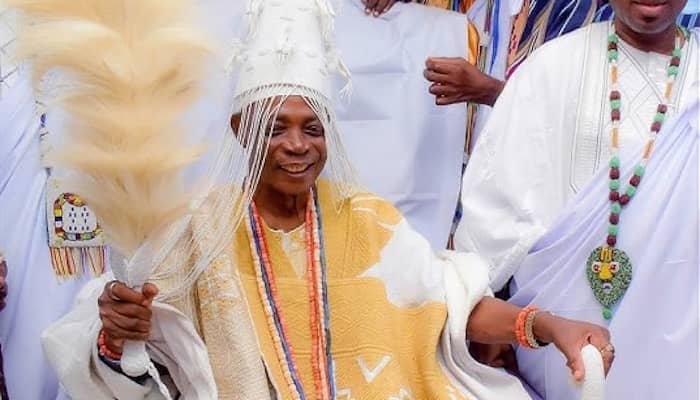
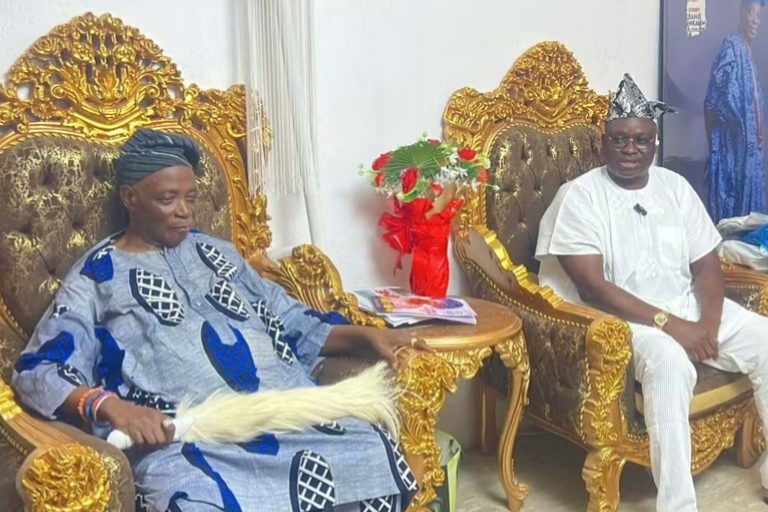
In advance public affairs, silence is rarely a neutral baseline. It is a canvas upon which the public draws its own conclusions, and in the volatile arena of political discourse, those conclusions are seldom charitable.


When a high-profile claim directly implicates the exalted throne of the Olubadan, the continued silence from the palace transcends a mere matter of royal style or media strategy. It becomes a matter of profound public interpretation.

The public is left with a burning, unavoidable question: What is between the Olubadan and Ayodele Fayose that remains hidden from us?
This question is not born out of idle curiosity, but out of a necessity to protect the integrity of a traditional institution that stands as a beacon of Yoruba heritage. When a former governor makes sweeping assertions that touch upon the palace, the throne is not being asked to descend into the mud of partisan combat. It is being asked to defend its own institutional purity.
History has shown us, repeatedly and painfully, that silence in the face of serious allegations is a dangerous gamble.
We need look no further than the political trajectory of former Vice President Atiku Abubakar to understand how a refusal to answer accusations can backfire. For years, former President Olusegun Obasanjo leveled a barrage of unfounded allegations against Atiku within the pages of his three-volume memoir, My Watch.
Because Atiku chose a path of restraint and kept silent, political opponents seized upon those uncontradicted narratives, using them as political weapons to shape public perception.
Unrebutted allegations, over time, calcify into “facts” in the public imagination. Silence allowed the opposition to weaponize a one-sided story.
If the Olubadan palace refuses to speak out now, it risks repeating this exact historical error.
In public perception, an unanswered allegation swiftly transforms into tacit admission. If the palace stays mute, the public will naturally conclude that the Olubadan is aware of, or perhaps even complicit in, the narrative being peddled.
The urgency is heightened because this is not an isolated incident; it is part of a troubling pattern. This marks the second time this year alone that Ayodele Fayose has lobbed heavy allegations involving the traditional leadership of Oyo State—recalling an earlier, highly provocative claim that Governor Seyi Makinde harbored intentions to dethrone the Olubadan.
The danger of this recurring silence is that it leaves an open vacuum. In media and politics, a vacuum is always filled, usually by speculation, rumor, and the machinations of political actors who thrive on ambiguity.
• If Fayose’s claim is false, the palace must say so clearly.
• If it is a distortion of facts, the palace owes the public the correct context.
• If it is a reckless fabrication, the palace must reject it in unmistakable, authoritative terms.
Silence is not golden all the time. The longer this matter remains unanswered, the more it risks becoming a permanent stain on the public consciousness, irrespective of where the actual truth lies. The Olubadan throne is too sacred to be used as a pawn in contemporary political maneuvering. For the sake of history, clarity, and institutional dignity, the palace must break its silence and set the record straight.