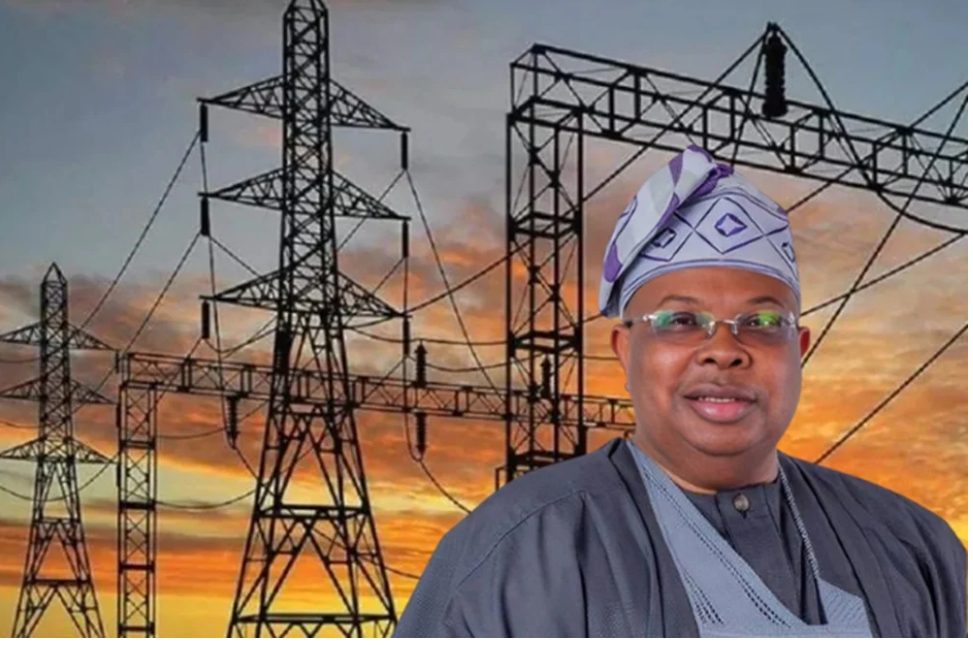
The current Minister of Power, Chief Joseph Olasunkanmi Tegbe, who assumed office on June 8, 2026, has been on the good side of news reports thus far. Aside from an occasion when he claimed his ministry had supplied too much power and Nigerians were begging him to scale it down, he has largely been seen as solution-driven. Quite unlike his immediate predecessor in that office, Adebayo Adelabu, who, incidentally, also hails from Ibadan, Oyo State, the new minister has been more forward-looking.

Adelabu told us the sector’s problems were more than 60 years old, and he introduced the BAND system as his solution. That created more problems than it solved, establishing an apartheid-style power supply system in the country in which some consumers were overcharged and under-supplied. He also supervised a succession of monthly grid collapses, which meant that the country spent millions of US dollars reviving failed plants while leaving the people in darkness for most of his tenure.
Upon assuming office, Tegbe announced what he called a reset of the power sector and declared that the administration would not impose new tariffs on the people but would focus on service improvement and protecting vulnerable users. He also announced a “24/7 Power Target,” universal metering, the clearing of legacy debts, the blockage of leakages that had left Generation Companies (GenCos) recovering only 27 per cent of their bills, the establishment of priority energy corridors (including Lagos-Ogun, which accounts for about half of national demand; Benin-Enugu-Port Harcourt; and Abuja-Kaduna-Kano), the construction of a $2 billion Super Grid, and a 17.7 MW mini-grid solar station to serve areas of Ibadanland. He has also taken the positive step of beginning the clearance of the 300 stranded containers carrying power equipment that had remained locked down at the ports for 20 years.
Those are constructive steps, though questions remain as to whether the $2 billion Grid project is an entirely new plan or a continuation of the programme announced by Adebayo Adelabu in 2025. That notwithstanding, Tegbe appears to be far more forward-looking than many ministers who have held the portfolio in recent years. Even if anyone wishes to debate that assessment, his commencement of the clearing process for the 300 stranded power containers should speak volumes for him.
But the Nigerian is known to defy good looks and good intentions. The system has been described as a complex web. Chairman of the Senate Committee on Power, Senator Enyinnaya Abaribe, who has served on that committee for three consecutive sessions since the 8th Senate, once observed of the sector thus: “For all have sinned.” It is a sector with many powerful subsidiaries, any one of which can undermine the success of the whole. There are upstream and downstream segments, and Minister Tegbe must beware of them all. He needs to watch particularly closely the activities of the downstream players—the distribution companies (DisCos), of which there are 11 across the country (with a twelfth, Aba Power, carved out of the Enugu Electricity Distribution Company).
Most of the distribution companies, except Eko, Ikeja and Aba, control multiple states. Aba Power serves mainly Abia State and the Abia South Senatorial District. Eko Electricity Distribution Company (EKEDC) covers most of Lagos Island, Lekki, Festac, Ojo and Epe, while Ikeja Electricity Distribution Company (IKEDC) covers Lagos Mainland, Ikeja, Oshodi, Abule Egba and adjoining areas. Jos Electricity Distribution Company (JEDC) covers Plateau, Bauchi, Benue and Gombe; Kano Electricity Distribution Company (KEDC) has Kano, Jigawa and Katsina; Port Harcourt Electricity Distribution Company (PHEDC) covers Rivers, Bayelsa, Cross River and Akwa Ibom; Yola Electricity Distribution Company (YEDC) controls Adamawa, Borno, Taraba and Yobe; Kaduna Electricity Distribution Company (KAEDC) runs Kaduna, Sokoto, Kebbi and Zamfara; Ibadan Electricity Distribution Company (IBEDC) covers Oyo, Ogun, Osun, Kwara, parts of Niger, Ekiti and Kogi; Enugu Electricity Distribution Company (EEDC) covers Enugu, Ebonyi, Anambra, Imo and Abia; and Abuja Electricity Distribution Company (AEDC) controls the Federal Capital Territory, Niger, Kogi and Nasarawa.
With such extensive networks, one would expect the DisCos to deliver competent service and make good business. Each of the areas of coverage has a population in millions, and that should be a huge advantage to the DisCos. What we have seen instead is that the companies ended up recruiting some of the bad eggs that made the old NEPA and PHCN loathed organisations in Nigeria. The DisCos have shown little sign of operating as private companies whose purpose should be to provide service and maximise profit for their stakeholders. Which private organisation would knowingly allow its primary source of revenue (transformers in this case) to deteriorate when a timely intervention could restore it to optimal use? Which private company would tolerate internal sabotage and continue to accommodate the staff responsible?
The DisCos often behave as though manna falls from heaven and they need not trouble themselves much about revenue generation. This attitude cuts across virtually all of them. The fact that the Federal Government still holds a 40 per cent stake may be one reason for their lack of commercial zeal. Whatever the cause, the distribution companies are not performing well, and any good intentions a Minister of Power may have can easily be undermined by their nonchalance.
Unfortunately, the DisCos are also the principal radar by which the performance of the entire sector can be monitored. Generation companies have their own difficulties, but it has long been observed that the distribution companies leave the widest gap. The country routinely generates in excess of 5,000 MW, yet the DisCos cannot take more than about 4,000 MW; there have even been instances of power being rejected by them. Imagine a registered distributor turning down the opportunity to receive more product and expand sales.
The DisCos complain of power theft and of customers’ failure to acquire prepaid metres. Yet their own staff are frequently the guilty parties. I can recall occasions when DisCo staff in Lagos approached me with accounts of how they helped neighbours reduce their electricity expenses. I have seen the same pattern in Abuja, Ibadan and elsewhere. On a popular street in Ibadan, most houses pay little or nothing for electricity; they are assisted by IBEDC personnel who load tokens on their behalf and bypass most electricity-consuming items.
One particularly striking case involves a Nigerian living in the diaspora who returns regularly to his base in Ibadan. He may stay for three months or more, yet pays only about ₦20,000 to the distribution company. For much of the time, the air-conditioners and heaters run whether he is at home or not. He simply sends the ₦20,000 to his contact “electrician,” who loads the prepaid metre and bypasses the ACs and all. Remarkably, power supply is usually stable when this diasporan comes around, but he pays only about N20,000 to IBEDC. Only God knows what his collaborators in the company charge him. Before his arrival, his agents (possibly IBEDC staff or electricians working with them) bypass key circuits so that only the company and the ghosts bear the cost.
Who bears responsibility for such practices? Ultimately, the DisCo must take charge itself. A private company that identifies areas of leakage and leaves them unplugged is failing in its basic commercial duty. There was a time when distribution companies experimented with metres installed on electricity poles. Why was that approach not sustained if it reduced tampering? Where a feeder persistently reports high losses, staff connected with it should be warned and, after some warnings, surcharged. Power theft must be brought to an end, and one of the most effective means is reliable supply combined with compulsory metering of every customer.
At present, workers in the distribution companies show little enthusiasm for getting prepaid metres to customers, and the DisCos themselves are not eager to accelerate metering. This is because the system—or successive Ministers of Power—has allowed them an easy way out. If the Minister were to issue an ultimatum that estimated billing would cease from, say, April next year, the DisCos would sit up. But because they are permitted to bill people for power that was never supplied, they remain relaxed when equipment is faulty and look the other way when their staff helps consumers bypass payment.
The Minister might usefully ask when any DisCo last installed transformers in residential localities, or last replaced ageing cables and poles. What do their customer-relations systems look like? What can they point to as meaningful corporate social responsibility? Too often the distribution companies behave as though they are doing consumers a favour, when they should be actively seeking to maximise legitimate revenue. Customers can be left for weeks unable to load credit onto their metres, with no alternative arrangement offered even when the failure is described as an unexpected technical blip.
Why can the power sector not take a cue from telecommunications? That industry began with high prices for telephones and SIM cards but quickly recognised that the more people on the network, the better. Prices were reduced, and a pay-as-you-go model was entrenched. Today, the telecommunications sector has transformed daily life and is a major contributor to GDP. The power sector has the potential to influence Nigerian lives even more profoundly. For that to happen, the Minister of Power may need to put real pressure on the DisCos—bypassing the Nigerian Electricity Regulatory Commission (NERC) if necessary, since that body is fast becoming a toothless bulldog (or worse, a quiet collaborator in keeping the nation in darkness). The Minister should breathe down the necks of the DisCos and force them to wake from their deep slumber.
Published by the Sunday Tribune, November 22, 2026).