
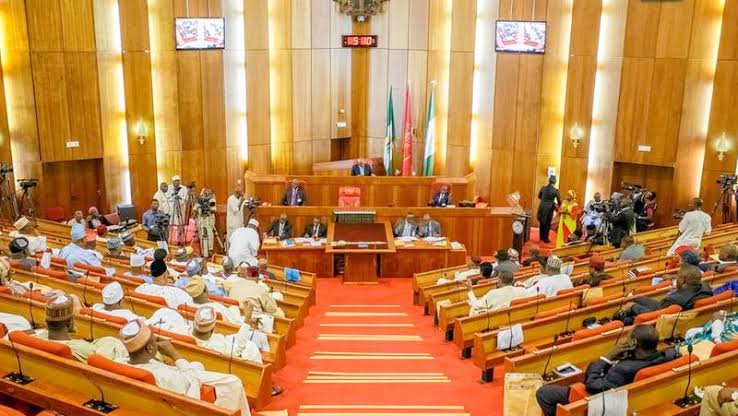
The Senate on Wednesday passed the Constitution Alteration Bill seeking to establish state police across Nigeria, marking a significant milestone in the country’s long-standing debate on decentralising policing to tackle rising insecurity.


The landmark legislation was approved after a clause-by-clause consideration by the Committee of the Whole and secured the support of more than two-thirds of senators through a manual voting process.

Senate President, Godswill Akpabio, announced the passage of the bill following an overwhelming endorsement by lawmakers during plenary.
The report on the bill was presented by the Deputy Senate President and Chairman of the Senate Committee on the Review of the Constitution, Barau Jibrin.
Leading the debate, Senate Leader Opeyemi Bamidele urged lawmakers to support the proposal, describing it as a critical reform aimed at strengthening internal security and improving responses to local threats.
The bill provides for a state policing framework that will operate alongside the existing federal police system, effectively ending the Federal Government’s exclusive control of policing.
A key provision empowers state governors to appoint Commissioners of Police for their respective states, subject to confirmation by their State Houses of Assembly.
Under Clause 17 of the proposed amendment, while the Federal Police Service will continue to be headed by the Inspector-General of Police, each State Police Service will be led by a Commissioner of Police appointed by the governor and confirmed by the state legislature.
The legislation also outlines the relationship between governors and state police commands.
Section 17(6) states that a governor may issue lawful written directives of a general policy nature to the Commissioner of Police on matters relating to public safety and public order within the state.
To address concerns about possible abuse of state police by political office holders, lawmakers included safeguards to protect civil liberties and political freedoms.
Section 17(7) stipulates that a State Commissioner of Police shall not arrest, detain, investigate or deploy force against any individual, political party or group solely for criticising the government, except in accordance with the law.
The provision is designed to prevent state police formations from being used against political opponents, journalists, activists or dissenting voices and ensures compliance with due process.
The Senate’s approval came shortly after lawmakers abandoned plans to use an electronic voting system for the consideration of constitutional amendment bills, including the State Police Bill.
The chamber adopted a manual voting process following concerns that technical glitches affecting some voting devices could disenfranchise senators and compromise the integrity of the exercise.
Supporting the switch, Bamidele argued that every senator should have an equal opportunity to participate in the historic vote.
Akpabio also endorsed the move, saying an open voting system would guarantee full participation and promote transparency by allowing Nigerians to know where their representatives stood on critical constitutional issues.
Among dignitaries present during the proceedings were Kaduna State Governor Uba Sani, Ogun State Governor Dapo Abiodun, Ondo State Governor Lucky Aiyedatiwa, and the Chief of Staff to President Bola Tinubu, Femi Gbajabiamila.
The passage of the bill represents one of the most significant constitutional reforms undertaken by the 10th National Assembly and is expected to reshape Nigeria’s security architecture if it receives the required approval of State Houses of Assembly and completes other constitutional processes.
Proponents of state policing have argued that the country’s centrally controlled police structure is overstretched and unable to effectively address growing security challenges such as banditry, terrorism, kidnapping and communal violence.
Critics, however, have warned that state police could be exploited by governors to intimidate political opponents and suppress dissent.
With the Senate’s approval, Nigeria has moved a step closer to establishing state-controlled police services operating alongside the federal police system.