


A group of prominent opposition leaders has raised alarm over what it described as the growing politicisation of key state institutions, particularly anti-corruption agencies, warning that the trend poses a serious threat to Nigeria’s multiparty democracy.
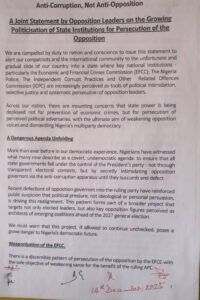
In a joint statement titled “Anti-Corruption, Not Anti-Opposition,” the leaders accused the Federal Government of allegedly deploying state power to intimidate and persecute opposition figures rather than genuinely combating economic crimes.
The statement, dated December 14, 2025, was signed by former Senate President, Senator David Mark; former Vice President, Alhaji Atiku Abubakar; Mallam Lawal Batagarawa; Chief Bode George; former Anambra State Governor, Mr. Peter Obi; and former National Chairman of the Peoples Democratic Party (PDP), Chief John Odigie-Oyegun.
The opposition figures said they were compelled by “duty to nation and conscience” to alert Nigerians and the international community to what they described as the gradual slide of the country into a system where institutions such as the Economic and Financial Crimes Commission (EFCC), the Nigeria Police and the Independent Corrupt Practices and Other Related Offences Commission (ICPC) are increasingly perceived as tools for political intimidation and selective justice.
According to the statement, there are mounting concerns nationwide that state power is being deployed not for the prevention of economic crimes, but for the persecution of perceived political adversaries, with the ultimate aim of weakening opposition voices and dismantling Nigeria’s multiparty democratic structure.
The leaders warned that recent defections of opposition governors to the ruling party have further fuelled public suspicion that political pressure, rather than ideological alignment or personal conviction, is driving the realignment.
They alleged that this pattern forms part of a broader agenda to ensure that all state governments fall under the control of the President’s party, not through transparent electoral contests, but by covertly intimidating opposition leaders using anti-corruption agencies until they succumb or defect.
Describing the situation as “a dangerous agenda unfolding,” the signatories cautioned that if the trend is allowed to continue unchecked, it could pose a grave danger to Nigeria’s democratic future, especially ahead of the 2027 general elections.

The opposition leaders also specifically accused the EFCC of being “weaponised” against opposition figures, alleging a discernible pattern of selective prosecution aimed at weakening the opposition for the benefit of the ruling All Progressives Congress (APC).
Quoting the words of civil rights icon, Martin Luther King Jr., the leaders warned against silence in the face of perceived injustice, stressing that Nigeria belongs to all citizens and not to a single party or individual.
They called on Nigerians, civil society groups and the international community to remain vigilant and to defend democratic values, insisting that anti-corruption efforts must be impartial, transparent and free from political manipulation.