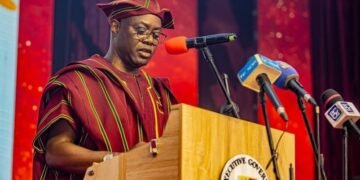

Early this morning, while scrolling through a WhatsApp platform, I encountered a remarkably lucid and courageous response by Dr. Johnson Adebayo Ojo, Provost of Oke Osanyintolu College of Health Sciences and Technology, Ido-Ekiti.
He was reacting to a voter who had taken it upon himself to criminalise an Ekiti Senator for failing to provide a transformer for a community. The clarity, constitutional grounding, and civic honesty of Dr. Ojo’s intervention were striking. I immediately placed a call to him. What followed was a robust, intellectually rich conversation that lasted nearly an hour. This article is, in many ways, a communique distilled from that engagement.
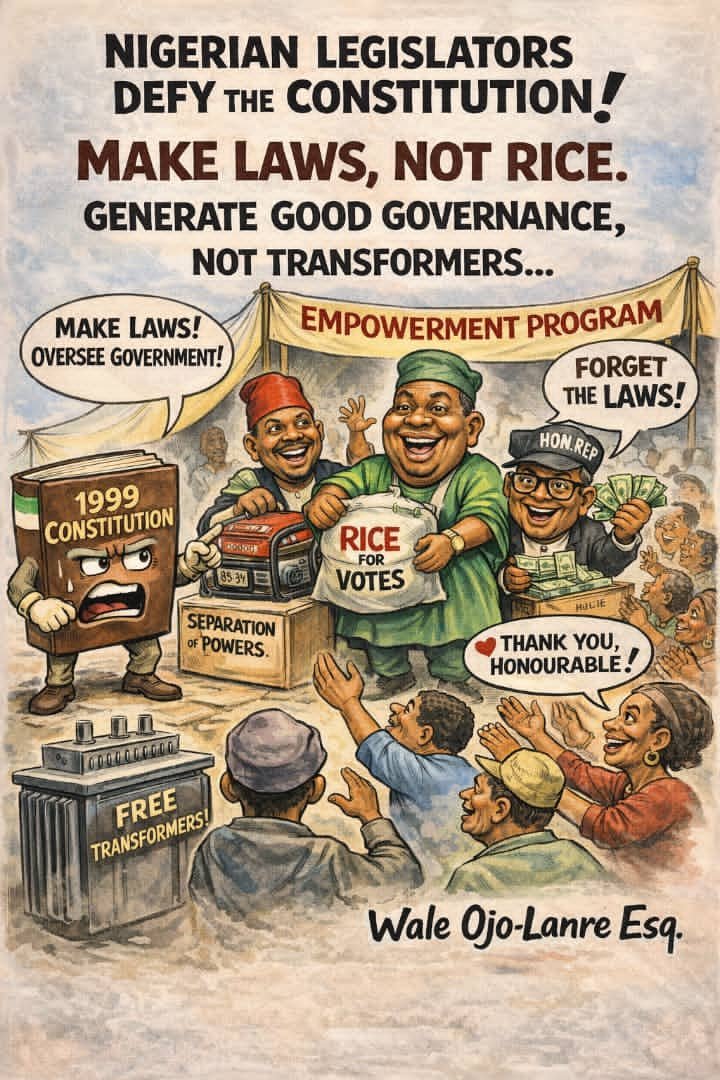
Nigeria is facing a quiet but profound democratic crisis—one not announced by coups, tanks, or decrees, but nurtured subtly by applause, poverty, misplaced expectations, and the steady erosion of constitutional understanding. It is a crisis of role confusion. Across the country today, legislators are increasingly celebrated not for the laws they make, the policies they influence, or the accountability they enforce, but for the quantity of rice, motorcycles, sewing machines, generators, and transformers they distribute. In this process, representative democracy has been reduced to charity, and constitutional governance has been mistaken for seasonal benevolence.
This development is neither accidental nor harmless. It represents a fundamental departure from what the Nigerian Constitution clearly envisages as the role of a legislator. Under Section 4 of the 1999 Constitution of the Federal Republic of Nigeria (as amended), legislative powers of the Federation and of the States are vested in the National Assembly and the State Houses of Assembly respectively, strictly for the purpose of making laws for the peace, order, and good governance of Nigeria or of a State. The wording is precise, deliberate, and exhaustive. Lawmaking is not one duty among many; it is the core mandate. Legislative relevance is anchored in ideas, statutes, debates, and policy direction—not in project execution or material distribution.
The Constitution goes further. Sections 88 and 89 empower the Legislature to conduct investigations into the conduct of ministries, departments, agencies, and any authority charged with executing laws or expending public funds appropriated by the Legislature. The purpose of this power is expressly stated: to expose corruption, inefficiency, or waste in the administration of laws and public resources. This oversight function presupposes distance, independence, and institutional objectivity. Once a legislator crosses into implementation through so-called empowerment programmes, that distance collapses, objectivity is compromised, and oversight becomes performative at best. One cannot, in good constitutional conscience, supervise what one is personally executing or promoting.
Nigeria’s constitutional architecture is founded on the doctrine of separation of powers—a doctrine that is not decorative but functional. The Legislature makes the law. The Executive implements the law. The Judiciary interprets the law. When legislators abandon lawmaking for the distribution of empowerment items, they collapse this structure and weaken the checks and balances that safeguard democracy. A legislator who distributes transformers today cannot credibly interrogate the Ministry of Power tomorrow. A lawmaker who executes projects cannot honestly investigate budget implementation without an inherent conflict.
The most common defence advanced for this deviation is poverty. Legislators argue that constituents are hungry and that empowerment programmes fill urgent gaps. Poverty is real, pervasive, and deeply troubling. But constitutional breach is not its solution. The Constitution already assigns social intervention, economic planning, and service delivery to the Executive arm of government, subject to legislative appropriation and oversight. When legislators attempt to fill this space, they do so outside their constitutional mandate, substituting systemic governance with temporary relief and weakening institutions in the process.
In truth, laws remain the highest, most enduring, and most democratic form of empowerment. A single well-crafted law can create jobs, regulate markets, protect the vulnerable, stabilise institutions, and shape national destiny for generations. A sound education law outlives a thousand sewing machines. A robust labour or economic statute empowers millions more sustainably than truckloads of rice. This is why in advanced democracies legislators are judged almost exclusively by legislative output and policy influence. In the United States, Article I of the U.S. Constitution vests legislative authority in Congress, confining members to lawmaking and oversight. In the United Kingdom, Members of Parliament are assessed by debates led, bills sponsored, amendments secured, and scrutiny exercised. No serious democracy measures legislative performance by handouts.

It is instructive that during Nigeria’s First and Second Republics, legislators were not known for empowerment jamborees. They were respected as thinkers, ideologues, debaters, and policy drivers. Figures such as Obafemi Awolowo, Aminu Kano, and Nnamdi Azikiwe were evaluated by the strength of their ideas, the laws they championed, and the institutions they helped build. The current obsession with empowerment by legislators is a relatively recent phenomenon, driven by worsening poverty, executive failure, weak civic education, and voter desperation. Yet it is not progress. It is democratic regression.
Perhaps the most tragic element in this distortion is the role of the voter. Democracy presumes a reasonable electorate capable of judging representatives by performance within constitutional boundaries. Ideally, voters should ask how their legislator voted on key bills, what laws they sponsored, how they contributed in committees, and whether they exercised courage in oversight. Increasingly, however, these questions have been replaced by inquiries about what was brought home and who benefited from empowerment. When voters reward handouts, they incentivise lawmakers to abandon Parliament for optics, turning governance into performance and institutions into afterthoughts.
There is nothing wrong with personal charity. A legislator may assist individuals from private resources as an act of compassion. But charity is not governance, and it must never be mistaken for representation. The moment charity replaces constitutional duty, democracy is diminished and accountability evaporates.
Nigeria must urgently re-educate both its lawmakers and its citizens. Legislators must return to Parliament to do the work for which they were elected: making laws, shaping policy, and holding the Executive accountable. Citizens must reclaim the right to judge representation by constitutional performance, not by palliatives.
Democracy is not sustained by rice. Development is not powered by generators shared in town halls. Nations grow through strong laws, functional institutions, and disciplined adherence to constitutional roles. A legislator who brings rice but fails to make laws has failed his mandate, no matter how loud the applause.
Legislators are for laws. Rice is not legislation. Transformers are not governance.
This piece is dedicated to Dr. Johnson Adebayo Ojo, Provost, Oke Osanyintolu College of Health Sciences and Technology, Ido-Ekiti, whose principled engagement and constitutional clarity stoked the reflections that gave birth to this article.