
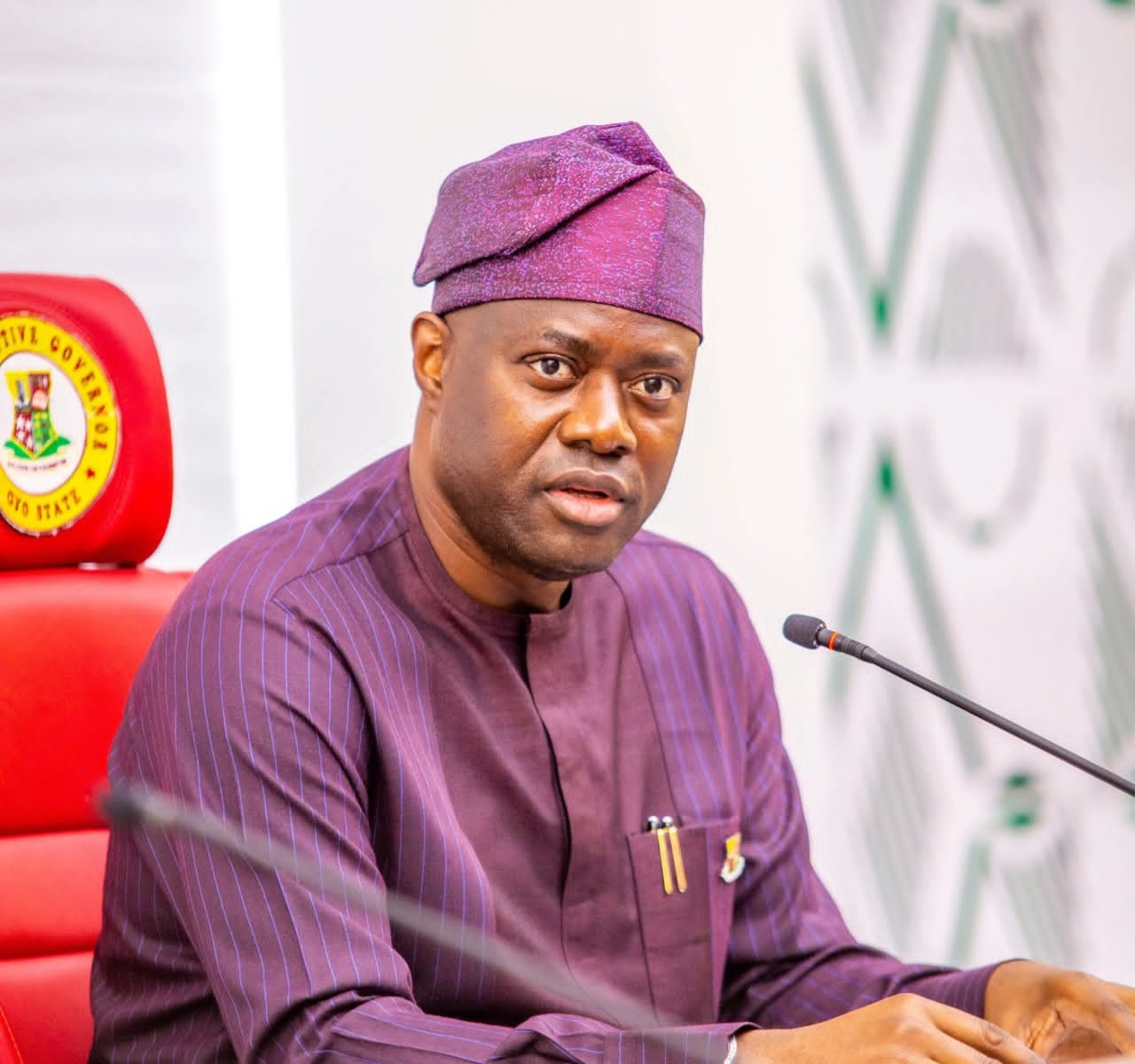
As the horizon clears for Nigeria’s high-stakes 2027 general elections, the political chessboard is witnessing the methodical, unhurried maneuvers of one of the country’s most astute sub-national leaders, Oyo State Governor, Engr. Seyi Makinde.


Often underestimated in the tempestuous theatre of federal politics due to his characteristic calm and calculated disposition, Makinde has quietly transformed himself into the anchor of a new political geometry.

Far from being a reactive participant, the Oyo helmsman is executing a masterclass in tactical patience, institutional positioning, and strategic coalition-building that is reshaping the path to 2027.
In a political climate traditionally dominated by brute force and monolithic party structures, Makinde’s approach is defined by calculated agility.
Rather than tying his political survival entirely to the friction-laden machinery of legacy structures alone, he has demonstrated a willingness to redraw lines when utility demands it.
His high-profile political realignments such as the strategic formations of the PDP-APM grand alliance framework underscores a pragmatic philosophy that coalitions are built on shared interests rather than blind loyalty.
From all indications, Makinde has positioned himself as a bridge-builder who can dialogue across ideological and party lines, thereby insulating himself against the internal implosions plaguing major opposition platforms, while keeping the ruling establishment perpetually on edge.
The foundation of the Makinde blueprint begins with sub-national legitimacy as a launchpad. Unlike politicians who seek federal office detached from a solid home base, Makinde has leveraged consecutive electoral mandates in Oyo State.
By anchoring his national appeal on tangible governance metrics, such as infrastructural expansion like the Rashidi Ladoja Circular Road, consistent workers’ welfare, and aggressive agribusiness drives, he enters the national arena with institutional credibility.
Furthermore, Governor Makinde understands the delicate nuances of Southwest politics. He carves out a distinct, independent identity within the region thereby acting as the primary alternative voice to the ruling All Progressives Congress hegemony, refusing to allow the zone to default into a one-party monolith.
Operating as a quiet strategist, while other aspirants make noise with early, uncoordinated declarations, Makinde moves like a chess grandmaster by studying the board, securing his flanks and striking only when the tactical window is mathematically optimized.
Also, Makinde’s masterclass in political engineering is most vividly displayed in how he is structuring the chessboard at home to secure a formidable succession and legislative depth.
Central to this calculated design is his tactical positioning of Hon. Bimbo Adekanmbi as the Oyo State gubernatorial candidate. By backing a figure known for sharp fiscal discipline, deep grassroots resonance, and technocratic competence, Makinde is engineering a seamless transition that guarantees continuity of purposeful governance in the pacesetter state.
Beyond the executive ticket, Makinde’s tactical genius shines brightly in his deliberate elevation of a new vanguard of young, brilliant, popular, lovable, and widely acceptable leaders into the electoral arena.
His strategic deployment of high-caliber names like Hon. Shina Peller, Hon. Stanley Olajide and Ambassador Olufemi Ajadi Oguntoyinbo as Allied Peoples Movement (APM) senatorial candidates for Oyo North, Oyo South and Oyo Central respectively, alongside a robust slate of dynamic individuals fielded as APM Oyo State House of Assembly candidates, reflects a masterstroke in coalition architecture.
By backing these vibrant political heavyweights across their respective strongholds, Makinde is effectively preempting structural bottlenecks, neutralizing opposition strongholds, and building an unbreakable multi-party legislative firewall.
This meticulous chess move ensures that his political family commands broad-based appeal across all demographics, fusing youth energy with institutional muscle to dominate both the ballot boxes and the legislative chambers.
Indeed, Makinde’s posture toward the 2027 horizon is not built on populist bluster; it is an exercise in structural positioning. Through formidable candidates, the engineer is engineering multi-party alignment and addressing a fundamental anxiety within the Nigerian electorate concerning the urgent need for systemic equilibrium and progressive inclusion.
Political pundits note that his brand of politics relies heavily on data-driven consensus. Makinde has successfully built economic corridors within Oyo State and expanded its Internally Generated Revenue. He projects a technocratic competence that appeals to a national audience fatigued by governance rhetoric devoid of fiscal discipline.
Moreover, his handling of opposition politics and satellite alliances demonstrates a rare commodity in Nigerian politics. When factions fracture, Makinde plays the role of the quiet stabilizer, rebuilding networks from the grassroots up.
Looking ahead, no high-stakes political game is without its hazards. Makinde’s calculated path requires walking a tightrope between balancing state governance and national ambitions, as maintaining peak governance delivery in Oyo State while executing a rigorous multi-tiered chess match demands exceptional delegation and political discipline.
Additionally, successfully managing a diverse coalition of independent-minded leaders requires elite ego management -a notorious hurdle in Nigeria’s democratic history.
However, if history is any guide, Makinde thrives in environments where expectations are quietly subverted. From his historic 2019 victory against the incumbent establishment in Oyo to his clinical consolidation in 2023, he has proven that his political survival instincts are second to none.
In conclusion, as 2027 draws closer, the narrative that money and noise dictate Nigerian elections is being steadily challenged by the quiet architecture of strategy. Governor Seyi Makinde’s tactical playbook proves that in politics, the loudest voice rarely wins the game; the player who controls the tempo, deploys brilliant minds into strategic offices and moves with mathematical precision does.
Whether this grand calculation culminates in a seismic shift at the ballot box remains to be seen, but one thing is certain: the 2027 political landscape cannot be written without factoring in the Ibadan tactician, Governor Seyi Makinde.