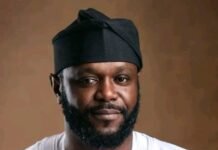


Ayobami Akinyode Olunloyo, a senatorial candidate for Oyo Central Senatorial District, has unveiled a six-point policy framework focused on employment, education, food security, healthcare, security, and heritage, pledging to promote transparent and accountable representation if elected.
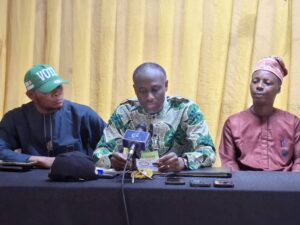
The Peoples Democratic Party PDP candidate made the pledge on Sunday, October 18, 2026, while addressing journalists at a press conference, where he explained his motivation for seeking election to the Senate.
Olunloyo said his ambition was driven by the belief that politics should improve people’s lives rather than serve as a platform for personal enrichment, political rivalry, or the interests of a privileged few.
Under his proposed framework, tagged *Making Life Work*, the aspirant identified six priority areas: *Iṣẹ́ Wa* (Work in Our Hands), *Ẹ̀kọ́ Wa* (Education for Our Children), *Oúnjẹ Wa* (Food on Our Tables), *Ìlera Wa* (Health in Our Households), *Ààbò Wa* (Safety in Our Homes), and *Ìní Tiwa* (Our Heritage and Future).
He said the framework would be guided by evidence, measurable results, partnerships, and public accountability rather than political slogans and unfulfilled promises.
According to him, his engagements with communities across the district had exposed infrastructure and social challenges, including poor road access, difficulties transporting farm produce to markets, and communities struggling to access reliable water supplies.
“Development is not what government announces. Development is what people can use,” he said, stressing that public expenditure should be assessed by the tangible benefits delivered to citizens.
He cited the co-sponsored rehabilitation of a road leading to the farm settlement in Dijo village and the joint repair of a borehole in Akeetan community, which he said had been out of service for three years, as examples of interventions within the district.
Olunloyo noted that Oyo Central comprises 11 local government areas spread across three distinct geographical zones: five around the Ibadan fringe, four around the Oyo town belt, and two along the Ogbomoso axis.
He argued that the different communities have varying needs and therefore require representation informed by grassroots consultations rather than a uniform approach to development.
Citing National Bureau of Statistics data, the aspirant said multidimensional poverty in Oyo Central was estimated at 44.8 per cent in 2022. He clarified that the figure did not represent unemployment and did not imply that all local governments experienced the same level of deprivation.
He called for a shift away from transactional politics, arguing that citizens deserved policies, opportunities, accountability, and sustained engagement beyond election periods.
“If all politics can offer people at election time is money, then politics has already admitted that it has nothing meaningful to offer them in government,” he said.
Explaining the responsibilities of a senator, Olunloyo said the office involved making and scrutinising federal laws, voting on budgets, questioning ministries and agencies, investigating project implementation through legislative committees, and representing constituents.
He, however, acknowledged that a senator does not exercise the direct executive powers of a governor or control every road contract, school, primary healthcare facility, or local government.
He pledged to use the legislative instruments available to him, alongside partnerships with federal institutions, national organisations, the private sector, international bodies, and development partners, to attract investment, expertise, and practical solutions to the district.
On constituency projects, Olunloyo said communities should participate in identifying priorities and have access to information about proposed projects, responsible agencies, budget allocations, fund releases, contractors, and implementation outcomes.
He also warned against the use of public projects to reward friends, relatives, or political allies, insisting that public funds must serve the public interest.
As part of his accountability commitments, the aspirant promised that, if elected, he would establish a searchable register of projects affecting Oyo Central within six months.
The proposed register would identify, where records permit, the relevant local government, responsible agency, budget trail, implementation status, and supporting evidence.
He also promised quarterly updates and annual public accountability meetings across all 11 local government areas.
Olunloyo said he would disclose stalled projects, explain delays, identify the agencies responsible for issues beyond his direct authority, and publicly correct any mistakes.
He further emphasised the importance of involving women and young people in identifying development priorities, designing opportunities, and assessing the effectiveness of interventions, describing them as partners and leaders rather than merely election-time mobilisers.
Addressing the performance of the incumbent senator, Olunloyo said he would not claim that the current representative had done nothing, describing such a position as unfair and factually unjustified.
Instead, he called for assessments based on what had become law, what had received funding, what had been released, what had been completed, and what continued to function.
The aspirant also spoke about his family background, acknowledging his pride in being the son of Chief Dr Victor Omololu Sowemimo Olunloyo and Chief Mrs Olufunmilayo Olaitan Olunloyo.
He maintained, however, that family heritage should not be mistaken for entitlement or a substitute for personal performance.
“The Olunloyo name may open a door. But it cannot do the work for me,” he said, adding that his preparation, decisions, and accountability would ultimately determine his record in public service.
He concluded by urging the people of Oyo Central to scrutinise his preparation, examine his record, question his promises, and measure his performance if elected.
“I will show up to listen. I will act to deliver. I will build to last,” he declared.
Olunloyo said his ultimate goal was to ensure that constituents could know what their senator was pursuing, what had succeeded, what had failed, and where their representative stood on issues affecting them.
He described his proposed approach as a politics of ideas, service, evidence, and accountability, anchored on the principle of “Making Life Work.”