

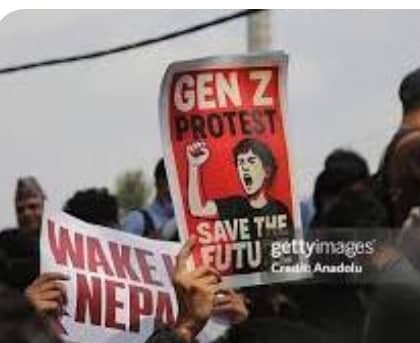
Woodrow Wilson once said, “The history of liberty is the history of resistance. And a people united against suppression is an unstoppable force. ” This age-long saying succinctly depicted the recent civil unrest in the South-east Asian state of Nepal that was fondly referred to as the Gen Z Uprising.
On September 4, 2025, the government of Nepal ordered the shutdown of 26 social media platforms, including YouTube, Facebook, Instagram, WhatsApp, and X, amongst others, for failing to register under the country’s Ministry of Communication and Information technology.
This was sequel to an earlier order issued by the government to these platforms, which the deadline given had elapsed. The government claimed that the registration was necessary to enable the enforcement of a new digital services tax and stricter value-added tax rules on foreign e-service providers in an effort to boost revenue.
However, critics alleged that the shutdown was prompted by an ongoing social media trend highlighting systemic corruption, nepotism, and lack of opportunities for the underprivileged. The “Nepo Kid” online trend focused on the undue privileges enjoyed by the children and relatives of the influential political leaders while the rest of the country wallow in deprivation and abject poverty.
This was against the backdrop of a 22% youth unemployment rate. A situation where 33% of the country’s GDP emanated from remittances from youths working abroad and on online spaces. These remittances keep thousands of households afloat in a country that indicates a lack of structural transformation in the domestic economy towards an employment first model for the teeming educated youths. Youths who were already frustrated over failed promises of politicians, government’s misuse of public funds, lack of transparency, and perversive inequality.
The shutdown of social media was the last straw. The median age of Nepal’s population is 25 years, meaning that a large part of the population was in the Generation Z (GenZ)category. This is the age group that uses social media the most. Youth participation groups, particularly Hami Nepal (a nongovernmental organisation), utilised Discord servers and Instagram channels to mobilse and coordinate plans for mass protest. Though the protest had no formal leadership, on September 8, a large gathering of youths was spotted around Kathmandu, the country’s capital and largest city. Subsequently, the demonstrations escalated when protesters attempted to gain access into the federal parliament building complex.
This move was resisted by the Nepalese armed police who responded with tear gas, water cannons, rubber bullets, and live ammunition, leading to the death of many protesters as online videos revealed numerous protesters being killed in front of the parliament building. The government immediately lifted the ban on social media, but it was too late. The killing of protesters had aggravated the situation and further enraged the protesters who had plunged into a frenzy of arson and wanton destruction of government facilities and buildings, much similar to what took place during the #Endsars protest in Nigeria after the October 20 shooting at Lekki toll gate.
In the course of the destruction, between September 8 and 9, several state institution buildings and personal structures of politicians were totally burnt down, which included the parliament building, the country’s administrative headquarters building, the President’s private residence, the ministry of health building, the country’s Hilton hotel amongst many other government buildings and residential buildings of the country’s influential people and politicians.

The country’s parliament was immediately dissolved, and the prime minister with a host of many other senior government officials voluntarily resigned from office, after which they were assisted by the country’s military forces, who had taken over the crisis situation, to escape to the city’s international airport, where the military were already stationed to provide security against the ravaging protesters.
Meanwhile, the protesters held online discussions to select an interim prime minister, and Sushila Karki, a former Supreme Court Judge, was selected amongst many other considerations. The country’s chief of army staff, General Ashok Raj Sigdel, who had released a press statement encouraging the protesters to remain calm while peace is restored to the country, called for a meeting that was held at the army headquarters on the 11th of September, where the Gen Z representatives were asked to provide a nomination for an interim prime minister. Sushila Karki, who had already been agreed upon at the online discussions, was put forward.
Thereafter, on the 12th of September 2025, Sushila Karki, a former Supreme Court chief justice, was inaugurated as interim prime minister to rule for six months, while March 5, 2026 was set as the date for the next elections. This brought to an end the crisis with a victory for the Gen Z protesters and the rest of the country’s citizens, though at very far reaching costs in human and material losses to the country. It was recorded that at least 72 people were killed, with 2,113 seriously injured, while an estimated 820 government and privately owned structures and properties were totally destroyed.
The 2020 #Endsars protest in Nigeria similarly brought the country to a brink as was witnessed in Nepal. And also similarly, it was a protest organised and coordinated by youths who were fed up with police brutality, as a flashpoint and final straw, but also discontented with the existing systemic corruption, massive unemployment, and relative deprivation in the country. Fortunately, the #Endsars protest did not end up with the overthrow of government as was experienced in Nepal. However, I think the government and indeed the entire country can learn some valuable lessons going forward, considering that the country’s youth mistrust in governance still persists.
Arbitrary arrest and detention of online social critics as had been witnessed in recent times under the guise of cyberbullying or any other form of media gagging only amounts to a violation of the rights to freedom of expression.
This is not the way to go in this digital age. As it has been clearly seen, social media is no longer a frivolous pastime. It is the modern public square where demands for accountability are voiced, and movements are born. Attempts to stifle it whether through bans or regulations only sharpen resistance. Additionally, Nigeria must confront its unresolved issues head-on. This means pursuing genuine police reforms beyond just political or administrative manoeuvring. It means addressing youth unemployment and fostering youth empowerment on a comprehensive scale beyond just creating government committees to provide handouts. It means providing and expanding opportunities for productivity and prosperity at home so that disillusioned graduates find no incentive to key into the japa syndrome. It demands an end to systemic corruption that siphons public wealth into private pockets of privileged few while ordinary citizens languish in abject poverty. Most importantly, it calls for the inclusion of the teeming youths in governance. With the youth having the highest percentage in the country’s population, young Nigerians should not be treated as passive subjects but as partners in progress and stakeholders in governance.
Finally, Nepal’s Gen Z Uprising reminds us that when governments ignore systemic failures, all it takes is a spark – a ban, a killing, a scandal – to ignite suppressed frustration. The path forward lies in proactive reforms, transparent leadership, and authentic engagement with the citizenry, particularly the youth population. Anything less could be an invitation for history to repeat itself.
Olusegun Hassan, Ph.D
Public Policy Analyst and Social Commentator