
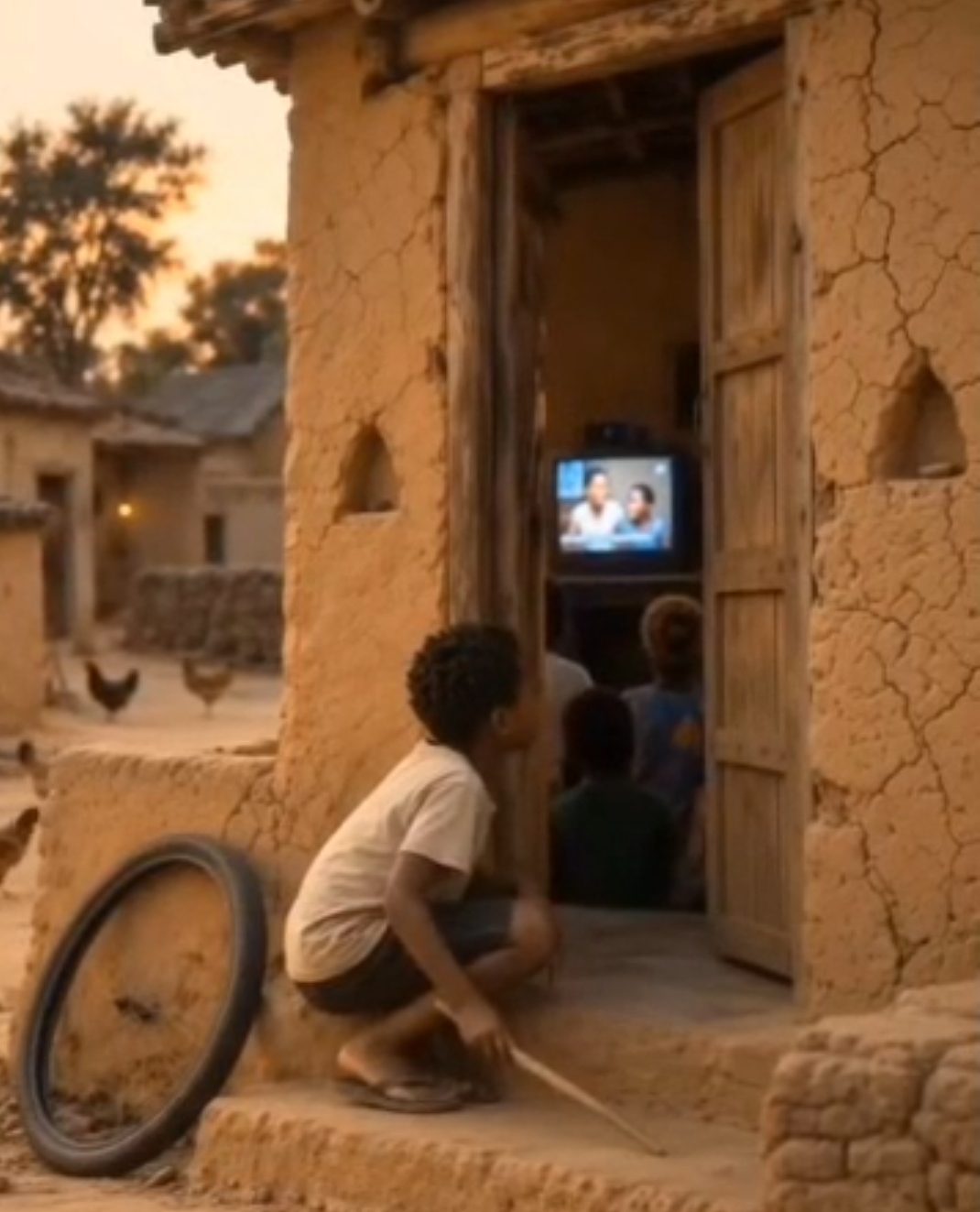
There was a time in Nigeria when owning a television set was a luxury reserved for a privileged few. In those days, television was not merely an electronic appliance; it was a symbol of affluence, a little window into a world that many could only dream of entering. For children from less privileged homes, watching television was an adventure that demanded courage, patience, and sometimes, the painful sacrifice of dignity.


We were children with eyes full of wonder but pockets empty of possibilities. While some children sat comfortably on sofas, enjoying the magic unfolding on their television screens, others stood outside their neighbours’ windows, stretching their necks, squeezing their faces between wooden frames, and stealing little moments of entertainment from a world that seemed determined to remain beyond their reach.

I was one of those children.
There were evenings when the glow of a television screen became our cinema, and the sound of a movie became the music of our childhood. We would gather around the windows and doorways of neighbouring houses, watching whatever portions of a film our positions permitted us to see. Sometimes, we arrived halfway through the story. Sometimes, we left before the conclusion. And sometimes, we never discovered how the story ended.
Yet, we kept returning.
Perhaps, even as children, we had begun to understand that the human spirit can find joy in the smallest openings, even when the doors to abundance remain firmly shut.
But life has a way of reminding the poor that even their little moments of happiness can be considered an inconvenience to those who have more.
One fateful day, while we were gathered around the window of a neighbour’s house, peeping into the world beyond the glass, the wife of the house owner poured water on us. In that moment, the innocent excitement of childhood was drowned in humiliation. We were not criminals. We were not thieves. We were merely children trying to enjoy what we could not afford.
But poverty has often placed innocent people in situations where their needs are mistaken for trespass, and their helplessness is treated as an offence.
I still remember the deeper meaning of that moment: how a child can be wounded without a single hand touching his body; how shame can settle upon a young heart long before the child possesses the language to explain what he feels.
Sometimes, the earliest scars of poverty are not written on the body; they are engraved upon the soul.
Providence, however, was quietly writing another chapter.
As fate would have it, my mother was returning from a journey that very day when she witnessed the incident. I cannot say what passed through her heart at that moment, but I imagine that a mother’s eyes must have seen more than children standing in the rain of another person’s anger. Perhaps she saw the little dreams that had brought us there. Perhaps she saw the indignity we could not yet explain. Perhaps she saw a childhood that deserved something better.
The following day, we had our own television set.
Just like that, the window that had once separated us from our little world of entertainment became a memory. We no longer needed to stand outside another person’s house, stretching our necks for a glimpse of what belonged to someone else. We could sit in the comfort of our own home, watch our movies to the very end, and enjoy the simple privilege that had once seemed like a distant miracle.
What changed overnight was not merely our access to television. Something deeper had happened.
A child who had once depended on the generosity of another household had discovered the freedom of having something of his own.
And in that small domestic victory, life quietly introduced me to one of its greatest lessons: the circumstances that humiliate you today do not possess the authority to determine the dignity of your tomorrow.
Today, we can afford more than a pack of television sets. What was once a luxury beyond our reach has become something we can possess in multiples. The window-side boy has grown, and the world that once seemed so far away has become a smaller place.
But whenever I remember those days, I do not merely count the distance between what we lacked and what we can now afford. I remember the child who stood outside a neighbour’s window with an innocent desire in his heart. I remember the water poured upon us. I remember my mother’s unexpected arrival. And I remember how quickly life can change when grace intervenes.
For what is a man’s life if not a long journey between the things he once desired, the things he struggled to obtain, and the things he eventually learns to understand?
There is a particular kind of childhood carried by children who grow up with a cross of vision upon their necks. They are children who see beyond their circumstances but have not yet acquired the means to escape them. Their minds travel to places their feet cannot reach. Their imagination dines at tables their families cannot afford. They dream in colours that their immediate environment cannot reproduce.
Such children often carry an invisible burden.
They must learn to hope without evidence, desire without possession, and imagine a future that their present circumstances seem determined to contradict. While other children may simply enjoy the comforts available to them, the child with a cross of vision must first learn to endure the painful distance between what he sees within and what he encounters without.
He is young, yet life begins to educate him in the language of denial.
He learns that some doors are closed, not because he lacks the right to enter, but because he lacks the resources to knock with confidence. He learns that some dreams must wait. He learns that the world does not always distribute its opportunities according to the innocence of its children.
And sometimes, he cries without tears, because he has not yet discovered how to explain the weight of a dream to people who are busy surviving their own realities.
The tragedy of a child with vision is not that he sees what he cannot have; it is that he must often carry the burden of believing in what his circumstances have not yet permitted him to become.
Yet, there is something beautiful about such children.
Their limitations can become laboratories of imagination. Their disappointments can deepen their understanding of human dignity. Their hunger for little things can teach them to appreciate great things. And their early encounters with rejection can awaken a tenderness towards others who stand outside the windows of life, hoping for an opportunity to be seen.
Not every child who watches through a window will grow up to own what he once admired. Not every painful beginning will produce a triumphant ending. Life is more complicated than the comforting stories we tell ourselves. But when grace meets perseverance, when opportunity meets preparation, and when the human spirit refuses to surrender its capacity to hope, yesterday’s deprivation need not become tomorrow’s definition.
That is why I look back with gratitude rather than bitterness.
I do not remember that neighbour’s house merely as the place where we were humiliated. I remember it as a chapter in the story that taught me how precious dignity is. I do not remember our first television merely as an appliance purchased after a painful incident. I remember it as a reminder that life can move a person from the margins of an experience to the comfort of a new reality.
And I remember my mother.
Sometimes, the miracle a child needs is not a wealthy family, an influential connection, or an extraordinary opportunity. Sometimes, it is simply a mother who sees his pain and possesses the will to change his circumstances. Sometimes, grace arrives in ordinary clothes, through the hands of someone who loves us enough to refuse to let our humiliation have the final word.
Years later, the television sets may multiply, houses may become more comfortable, and the possessions that once seemed extraordinary may become ordinary features of everyday life. But the true measure of progress is not how many things we have accumulated. It is whether we have retained the humanity to remember those days when we had so little.
For what is the value of rising above poverty if we become contemptuous of those still struggling beneath its weight? What is the meaning of success if it makes us forget the pain of exclusion? And what is the purpose of having more than enough if we cannot recognise the child standing outside the window, hoping for just a little room in somebody else’s world?
Perhaps the greatest achievement of the child who once watched through a window is not that he eventually acquires the things he could not afford. It is that, having experienced exclusion, he can become the kind of man who opens doors rather than pours water on the hopes of others.
The world does not need more people who have merely escaped their humble beginnings; it needs people whose humble beginnings have taught them how to treat others with dignity.
Today, when I look at the journey from that little boy peeping through a neighbour’s window to the man who can afford more than a pack of television sets, I see more than material progress. I see time, struggle, providence, memory, and grace woven into one human story.
I see a boy who could not watch a movie to the end, yet whose own story continued beyond the frame through which he once watched the world.
I see a child who was denied a little comfort, yet was not denied the possibility of a different tomorrow.
And I see a reminder that we must never judge the final chapter of a life by the poverty of its opening pages.
Some children are born into abundance and spend their lives learning the value of what they have. Others are born into scarcity and spend their lives carrying the burden of what they hope to become.
The latter may walk more difficult roads. They may endure humiliations that others will never understand. They may carry invisible crosses that make childhood heavier than it should be. But their stories deserve to be told, not because suffering is beautiful, but because the human spirit deserves recognition for surviving what it never chose.
I was once that boy.
A boy standing by a window, looking into a world he could not yet afford to enter.
A boy who did not know that the tears of one afternoon would become a memory from which he would one day draw wisdom.
A boy whose dreams were larger than his circumstances, whose desires were simpler than his struggles, and whose future was hidden behind the veil of time.
Today, I understand that the window was never merely a window. It was a symbol of the distance between desire and possession, between the life we live and the life we imagine, between the limitations of the present and the possibilities of tomorrow.
And perhaps that is the cross some of us must carry: to see beyond our circumstances without allowing our circumstances to destroy what we see.
For the boy with a cross of vision upon his neck must learn to walk with both pain and hope, carrying the weight of what is while remaining faithful to the possibility of what could be.
He must understand that not every window will open, not every hand will help, and not every dream will arrive according to his timetable. Yet he must never permit the cruelty of a moment to convince him that his entire life is destined for humiliation.
One day, the boy may become the man who opens the very doors that were once shut against him.
One day, the child who watched from outside may create a place where others are welcomed inside.
And one day, when the possessions of his present have become ordinary, he may look back at the poverty of his past and discover that the greatest wealth he acquired was not what he could now afford, but what his difficult beginnings taught him never to forget.
I was once a boy who watched the world through a window. Today, I understand that some windows are not merely meant to be looked through; they are reminders of the doors we must one day find the strength, wisdom, and grace to open.
— Chris Ayantoye