
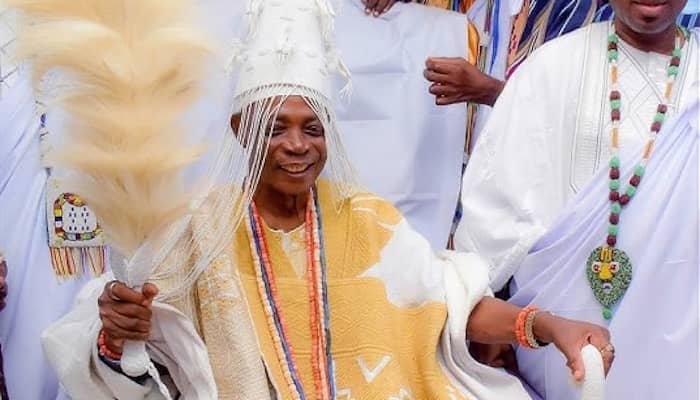
The attention of concerned sons and daughters of Ibadan has been drawn to the report titled “2027 Endorsement: We Abide With Olubadan’s Decision – Ibadan Traditional Institution.” While we respect the revered institution of the Olubadan and acknowledge the dignity and authority attached to the throne, there is a fundamental issue that must be addressed: the Ibadan traditional institution is a traditional institution, not a political institution.


The Olubadan is the paramount traditional ruler of Ibadanland. His position should transcend partisan politics. The strength and dignity of the Olubadan stool lie in its ability to remain the father of all—irrespective of political party, religion, social class or personal political preference.

Traditional rulers, like every other citizen, have the right to their personal political opinions. However, there is a significant difference between a traditional ruler exercising his personal democratic right and the entire traditional institution being presented as a political structure supporting a particular candidate or party.
That distinction must not be lost.
If the Olubadan personally supports a candidate, that is his constitutional right and should be respected. But it does not automatically mean that every Mogaji, Baale, traditional chief and indigene of Ibadan has surrendered his or her political choice to the palace.
Ibadan people are politically sophisticated enough to make their own choices.
This is why the recent political atmosphere surrounding the palace deserves serious reflection. You mentioned Dotun Sanusi. Who is he in this matter? If, as many people witnessed, individuals—including some Mogajis—were gathered around the Ilaji farm and political slogans such as “APC,” “Alli” and “Tinubu” were openly heard, then those who facilitated or encouraged such political mobilisation cannot now pretend that partisan politics came from only one side.
What a shame.
This is not an attack on Dotun Sanusi or on anybody’s political affiliation. If he supports APC, Senator Sharafadeen Alli, President Bola Ahmed Tinubu or any other candidate, he has every democratic right to do so. The question is whether that political mobilisation should be brought into the palace and subsequently presented as the collective position of the traditional institution.
You cannot invite politics into the palace and then blame only those who respond to the politics.
If what some people now describe as a “palace coup” is indeed how the recent events are perceived by many observers, then the first responsibility is to examine how the process began, who mobilised whom, and who first brought political alignment into the traditional space. It is unfair to blame only the other side without examining the actions that created the situation in the first place.
The Olubadan institution is bigger than APC. It is bigger than APM. It is bigger than Senator Alli. It is bigger than President Tinubu. It is bigger than Governor Makinde. It is bigger than every politician seeking power in 2027.
The palace belongs to all Ibadan people.
The phrase “we abide with the Olubadan’s decision” also requires clarification. We should abide by the authority of the Olubadan in traditional matters and respect the institution. But in a democratic society, political allegiance remains an individual choice. No traditional ruler, however respected, can constitutionally determine how every citizen must vote.
The danger of turning the palace into a partisan political arena is that the institution could lose the neutrality that has made it a unifying symbol for generations.
Imagine an Ibadan indigene who supports another political party entering the palace and hearing political chants in support of his or her opponent. Should that person still feel that the palace belongs equally to him?
That is the question we must honestly answer.
Ibadan’s traditional institution should be the bridge between political camps, not another political camp. Traditional rulers should be fathers to all, while politicians should be left to play politics outside the palace.
Let us therefore stop pretending that only one side is responsible for the politicisation of the traditional institution.
If you opened the door for partisan politics to enter the palace, you must accept responsibility for the politics that followed.
Nobody should disrespect the Olubadan. Nobody should undermine the traditional institution. But equally, nobody should hide behind the dignity of the palace to turn a traditional institution into a political machinery.
The 2027 election will ultimately be decided by the people at the ballot box. Let every candidate present his or her record, competence, character and programme. Let the people decide.
And let the Olubadan remain what he ought to be:
The father of all Ibadan people—not the political father of one party or one candidate.
The palace is bigger than 2027.
Ibadan is bigger than politics.
The Olubadan institution must remain above partisan politics