ADVERTISEMENT
  • Home
  • About Us
  • Contact Us
  • Privacy Policy
  • Advertise Here
  • Login
National Insight News
Advertisement
  • News
  • Politics
  • Business
  • Entertainment
  • Sports
  • Health
  • Tourism
No Result
View All Result
  • News
  • Politics
  • Business
  • Entertainment
  • Sports
  • Health
  • Tourism
No Result
View All Result
National Insight
No Result
View All Result
Home Featured

Obasanjo Farms, MRS, University Press, 10 Others Shut by Oyo Government

by NationalInsight
September 18, 2018
in Featured, News
Reading Time: 3min read
0
38
SHARES
472
VIEWS
Share on FacebookShare on TwitterShare on WhatsApp

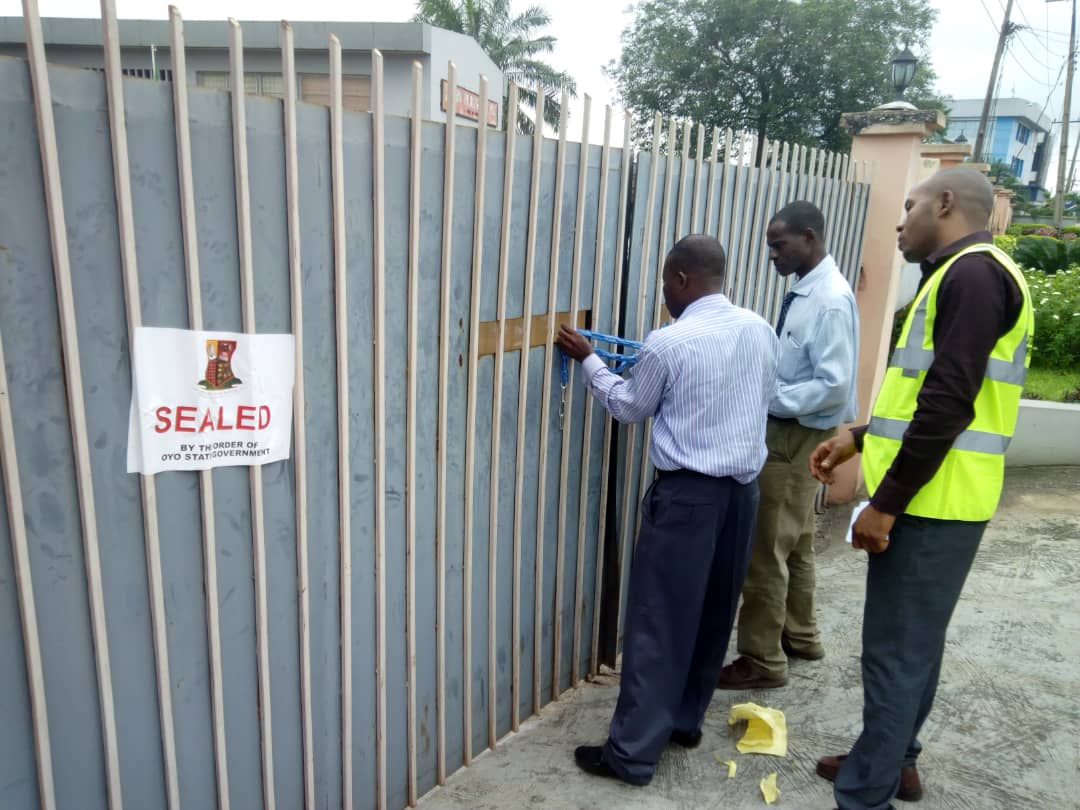
In continuation of its aggressive tax drive, the Oyo state government on Tuesday shut down the business premises of Obasanjo Farms, located in Oluyole Industrial Estate, Ibadan, MRS oil in the Oyo state capital city.

The farm is one of the sixteen other business organizations that were shut for defaulting in the payment of the environmental development levy due to the state government.
The companies are said to have defaulted in the payment for the year 2017 and or 2018.

The exercise by the combined task force teams of the Oyo State Inter-ministerial Enforcement Unit was being coordinated by the Oyo State Board of Internal Revenue.

You might also like

Team Nigeria Impresses with Strong Finishes, Qualifications at World Relays

After NWC Ouster, Wabara-Led BoT Moves to Stabilise PDP

World Press Freedom Day 2026: Ex NUJ President Urges Nigeria to Move Beyond Rhetoric on Media Freedom

Load More

Locations visited by the task force team included Dugbe, Eleyele, Podo, Challenge, Onireke areas of the capital city.

Some of the other firms affected in the seal up by the task force team include Black Horse, Heinemann Educational Books, Lister Flour Mills, and University Press Limited.

Others are Evans Brother, Brooking House, Group Medical hospital, Butterfield bakery, Chicken Republic, MRS oil and Rasmed publicity.

While addressing the press, the chairman, Oyo state Board of Internal Revenue (OYBIR), Mr. Bicci Alli said the exercise became inevitable due to the failure of the affected firms to comply with the state tax laws after series of formal communication failed.

Stressing that the enforcement will be continuous, he warned all corporate organizations in the state to do the needful and be corporately responsible in line with the laws of the land.

ALSO READ  Buhari/Osinbajo 2019 : YYF Not Part of Afenifere's Endorsement - Bolarinwa

He said “the exercise we carried out today (Tuesday) is not something new and not outside the law. It is within the law. We went to restrain some corporate organizations that failed to pay what is due to Oyo state government after giving due notices, demand notices and even public notices to that effect and they failed to pay.

“So we went to those places to distrain them from having access to their premises and it’s going to be a continuous exercise, all through the week and even next week.

“What they are guilty of is the payment of the environmental development levy. Some of them owe about two years. We wrote to them and gave them notices to pay, they refused to pay. It was as a result of their failure to pay that we now embarked on the needful.

“But it’s so sad that not until we have to take this step against the firms that they are now actually coming out to pay.

“Government is not interested in disrupting the business of these corporate organizations, the business of government is to create an enabling environment for business to thrive which Oyo state government has done tremendously well in the last few years and that’s why you see businesses springing up on daily basis in Oyo state.  The government cannot disrupt their businesses unless where it is absolutely necessary.

“The focus now is that we will collect every kobo that people are owing the state government, we did publication on August 13, in two widely read newspapers, drawing the attention of corporate organizations and individual residents of Oyo state to pay all their taxes, dues and levies that are supposed to pay to the state government within 14 days.

ALSO READ  FIRS Begs CAN, Christians Over 'Offensive' Easter Message

“But that was like a reminder, prior to that: we served demand notices in line with extant laws on corporate organizations, individuals to pay their taxes. Some of the taxes are due early January, February, March, depending on the position of the law. However, when they failed to pay, we did the reminder in line with the position of the law and we now did a public notice on 14th August, giving them 14 days to be able to pay. So, nobody could tell us that they were not informed.”

author avatar
NationalInsight
See Full Bio
Tags: Obasanjo FarmOyo state tax
Share15Tweet10Send
Previous Post

Tegbe In The Vile Perspective Of Fifth Columnist. By Gbolagade Akinola

Next Post

Bafarawa Promises Better Nigeria if Elected as President

NationalInsight

NationalInsight

Related Posts

#image_title
Featured

Team Nigeria Impresses with Strong Finishes, Qualifications at World Relays

by NationalInsight
May 4, 2026
103
#image_title
Featured

After NWC Ouster, Wabara-Led BoT Moves to Stabilise PDP

by NationalInsight
May 4, 2026
103
*NIGERIA* : _A country where corruption makes rulers deaf, dump and blind_ _Corruption is the enemy of development, and of good governance. It must be got rid off. Both the government and the people at large must come together to achieve this national objective._ *_Pratibha Patil_* . The discourse on corruption in Nigeria remains an endless talk-shop simply because both leadership and followers are deeply enmeshed in the scourge. Nigeria’s corruption has become a virus that is ravaging the entire landscape to the extent that it would take God’s intervention to recover the country from its stranglehold. The author quoted above, would suggest that corruption is an African issue. I however disagree. The “pandemic” is not restricted to Nigeria or Africa alone. Western societies are not exempted. I dare say that the Western nations, more than any other, are culpable in the performance, though at the extra territorial level. While jealously guarding their own treasures and appropriating resources for their own people, they navigated the length and breadth of the globe, exploiting other countries, for selfish interest. They corruptly enriched their countries, with the wealth, toll and blood of others. African slaves build their cities while its resources served their economies. It would take eternity to discuss corruption, but for a quick grasp of the phenomenon, Nigeria as a nation would serve the purpose of my attempt to discuss this nagging social concern. There is phenomenal corruption in our country simply because there is a profound failure of leadership generally and in the fight against corruption in particular. If the truth is to be told, with very few exceptions, our crop of leaders is essentially self-serving and visionless. Some even rank as despots, and not leaders in the true sense of the word. They lack(ed) vision, focus, selflessness and are indulgent on a large scale. Without fear of contradiction, our leaders are unimaginably corrupt; they are greedy; they are vindictive; they are reckless and, in many fundamental respects, senseless. Virtually whoever has access to power abuses it. The exceptions are very few indeed. There is perhaps no other country in the world where power corrupts and absolute power corrupts as absolutely as in Nigeria. Our indisputable consistent dismal ranking on the global corruption index testifies to the societal decadence and poverty of leadership that bestrides the country, yet we gloat over this shameful misnomer, wear its badge with pride and carry on like Nero of Rome. That the so-called African leader and hope of the black man is now donning the crown of corruption and poverty headquarters of the world, without qualms, in incomprehensible. Like a deaf and blind man, he hears nothing, he sees nothing. Our leaders hear nothing, they see nothing. Nothing moves them. What a shame! While yet adorning their corruption epaulet, those who plunged the country into the ditch are moving around with full chest, parading credentials of ‘sainthood’ and superiority. Yet our society keeps applauding them as people with morals and means. Each opportunity they had in providing leadership became personalised. Citizens are compelled to embrace their warped ideology. They are subjected to mental and material poverty and reoriented to believe that except one identifies with the loyalist camp, chances of enjoying any benefit from the state, even one’s survival, is slim. The promoters of that bastardization are walking the streets unchallenged of their evil deeds. This same attitude was what brought our country to its knees. Its assets are decimated, its infrastructure lying in runs. Our education system has been destroyed, health facilities are in comatose, shipping lines have become moribund, in short, Nigeria has been destroyed. Look at what happened in this country in the 1970s! Where are all the River Basins? Where are the industries? Where are the motor companies? Volkswagen of Nigeria, so many of them? These industries were all destroyed between 1986 and early 1990’s. At that time, if you were in their good book, they would likely issue you license to establish a bank. You can turn the bank into whatever you like. If you were favoured, you could get a license for oil block or whatever catches your fancy. At some point, the government was simply personalised. I say this on good authority. Some Nigerians who were in the security services in the country, would attest to these facts. The country’s security agencies were turned into laboratory of sorts to test all kinds of fantasies. In all honesty, the meaning of corruption goes well beyond the meaning normally adduced to it in Nigerian public discourse. For, corruption means much more than public officers taking bribes and gratification, committing fraud and stealing funds and diverting resources, entrusted to their care. Corruption, in my view, means a deliberate violation, for gainful ends, of standards of conduct legally, professionally, or even ethically, established, in private and public affairs. These gains may be in cash or in kind or, it may even be psychological or political but they derive from the violation of the integrity of an entity and involve the subversion of its quality and capacity, going by the definition of the late erudite scholar Bala Yusuf Usman in one of his submissions on corruption. Corruption is one of the major problems which Nigeria has to tackle and overcome if it is to make any significant and sustainable progress in 21st century. Former President Olusegun Obasanjo instituted two anti-graft agencies within a space of three years (ICPC September 2000 and EFCC in 2003). Can we say they have been able to stem corruption? Rather it's on the increase. Instead of looking inward to see the underlying factors that had inhibited efforts to curtail the scourge, the campaign now is targeted at eradicating or muzzling the mouth of the oxen that “threaded out the corn.” The kingpins of corruption are resolute to emasculate the campaign. It must not be allowed to continue. It must be silenced so business can continue as usual. The main reason for the failure of Buhari’s - military regime’s - campaign against corruption and indiscipline was the regime’s inability to deal effectively with the problem of economic and social decline inherited from the preceding regime. The regime also shot itself in the foot by trying to arrest the country’s economic and social decline by doctrinaire and anti-people policies. massive retrenchment of workers in the public service, the introduction of many new taxes, levies and fees on citizens, drastic reduction in public expenditure, especially on social welfare and agricultural subsidies, and the widespread destruction of the means of livelihood of small privately employed persons like motor mechanics, food vendors and petty traders by pulling down their makeshift sheds, kiosks and bukas in the name of urban environmental sanitation. It would be unseemly for me to particularise further but I cannot over-emphasize the importance of eradicating this epidemic that has razed our nation to the ground. Any who has not lived among us may not be able to appreciate the extent to which bribery and other corrupt practices have wrecked our nation. Those who occupy positions of power operate in exclusion of the ideals of disinterested service. Much of the attraction of a post lies in the opportunities it offers for extortion of one form or another. Unless the commission fully realizes the gravity of this problem and tackle it with courage, any recommendations for marginal reform are bound to fall flat - dead on arrival. It is most troubling to see that only a handful of Nigerians especially public officials are people of integrity and honesty. Most educated Nigerians are citizens of two publics in the same society. On one hand, they belong to a civic public from which they gain materially but to which they give only grudgingly. On the other hand, they belong to a primordial public from which they derive little or no material benefits but to which they are expected to give generously and do give materially. To make matters more complicated, their relationship to the primordial public is moral, while that to the civic public is amoral. The dialectical tensions and confrontations between these two publics constitute the uniqueness of modern African politics” It is my conviction, as an ardent believer in possibilities, that Nigeria is not beyond change. Nigeria can change today if she discovers leaders who have the will, the ability and the vision to steer her in the right direction. I wholeheartedly agree with a school of thought that says “corruption in Nigeria has passed the alarming and entered the fatal stage and Nigeria will die if we keep pretending that she is only slightly indisposed”. Although many Nigerians may tend to share this view, the incurable optimist I am about the future of this country, make me to conclude that our tomorrow will be alright if we all submit to moral discipline in all its facets. Lanre Ogundipe Former President Nigeria and African Union of Journalists (NUJ/AUJ) writes from Abuja.
Featured

World Press Freedom Day 2026: Ex NUJ President Urges Nigeria to Move Beyond Rhetoric on Media Freedom

by NationalInsight
May 4, 2026
104
High Chief Barrister Olusegun Adeyemi Adekunle
Featured

Ogbomoso Anglican Diocese Installs Ashipa of Ogbomosoland  Bar Segun Adekunle as Chancellor

by NationalInsight
May 3, 2026
107
Dr. Jamilu Ishiyaku Gwamna
Featured

APC Adopts Gwamna as Consensus Governorship Candidate for 2027 in Gombe

by NationalInsight
May 3, 2026
126
Next Post

Bafarawa Promises Better Nigeria if Elected as President

Leave a Reply Cancel reply

Your email address will not be published. Required fields are marked *

This site uses Akismet to reduce spam. Learn how your comment data is processed.

Latest Post

#image_title

Team Nigeria Impresses with Strong Finishes, Qualifications at World Relays

May 4, 2026
103
#image_title

After NWC Ouster, Wabara-Led BoT Moves to Stabilise PDP

May 4, 2026
103
*NIGERIA* : _A country where corruption makes rulers deaf, dump and blind_ _Corruption is the enemy of development, and of good governance. It must be got rid off. Both the government and the people at large must come together to achieve this national objective._ *_Pratibha Patil_* . The discourse on corruption in Nigeria remains an endless talk-shop simply because both leadership and followers are deeply enmeshed in the scourge. Nigeria’s corruption has become a virus that is ravaging the entire landscape to the extent that it would take God’s intervention to recover the country from its stranglehold. The author quoted above, would suggest that corruption is an African issue. I however disagree. The “pandemic” is not restricted to Nigeria or Africa alone. Western societies are not exempted. I dare say that the Western nations, more than any other, are culpable in the performance, though at the extra territorial level. While jealously guarding their own treasures and appropriating resources for their own people, they navigated the length and breadth of the globe, exploiting other countries, for selfish interest. They corruptly enriched their countries, with the wealth, toll and blood of others. African slaves build their cities while its resources served their economies. It would take eternity to discuss corruption, but for a quick grasp of the phenomenon, Nigeria as a nation would serve the purpose of my attempt to discuss this nagging social concern. There is phenomenal corruption in our country simply because there is a profound failure of leadership generally and in the fight against corruption in particular. If the truth is to be told, with very few exceptions, our crop of leaders is essentially self-serving and visionless. Some even rank as despots, and not leaders in the true sense of the word. They lack(ed) vision, focus, selflessness and are indulgent on a large scale. Without fear of contradiction, our leaders are unimaginably corrupt; they are greedy; they are vindictive; they are reckless and, in many fundamental respects, senseless. Virtually whoever has access to power abuses it. The exceptions are very few indeed. There is perhaps no other country in the world where power corrupts and absolute power corrupts as absolutely as in Nigeria. Our indisputable consistent dismal ranking on the global corruption index testifies to the societal decadence and poverty of leadership that bestrides the country, yet we gloat over this shameful misnomer, wear its badge with pride and carry on like Nero of Rome. That the so-called African leader and hope of the black man is now donning the crown of corruption and poverty headquarters of the world, without qualms, in incomprehensible. Like a deaf and blind man, he hears nothing, he sees nothing. Our leaders hear nothing, they see nothing. Nothing moves them. What a shame! While yet adorning their corruption epaulet, those who plunged the country into the ditch are moving around with full chest, parading credentials of ‘sainthood’ and superiority. Yet our society keeps applauding them as people with morals and means. Each opportunity they had in providing leadership became personalised. Citizens are compelled to embrace their warped ideology. They are subjected to mental and material poverty and reoriented to believe that except one identifies with the loyalist camp, chances of enjoying any benefit from the state, even one’s survival, is slim. The promoters of that bastardization are walking the streets unchallenged of their evil deeds. This same attitude was what brought our country to its knees. Its assets are decimated, its infrastructure lying in runs. Our education system has been destroyed, health facilities are in comatose, shipping lines have become moribund, in short, Nigeria has been destroyed. Look at what happened in this country in the 1970s! Where are all the River Basins? Where are the industries? Where are the motor companies? Volkswagen of Nigeria, so many of them? These industries were all destroyed between 1986 and early 1990’s. At that time, if you were in their good book, they would likely issue you license to establish a bank. You can turn the bank into whatever you like. If you were favoured, you could get a license for oil block or whatever catches your fancy. At some point, the government was simply personalised. I say this on good authority. Some Nigerians who were in the security services in the country, would attest to these facts. The country’s security agencies were turned into laboratory of sorts to test all kinds of fantasies. In all honesty, the meaning of corruption goes well beyond the meaning normally adduced to it in Nigerian public discourse. For, corruption means much more than public officers taking bribes and gratification, committing fraud and stealing funds and diverting resources, entrusted to their care. Corruption, in my view, means a deliberate violation, for gainful ends, of standards of conduct legally, professionally, or even ethically, established, in private and public affairs. These gains may be in cash or in kind or, it may even be psychological or political but they derive from the violation of the integrity of an entity and involve the subversion of its quality and capacity, going by the definition of the late erudite scholar Bala Yusuf Usman in one of his submissions on corruption. Corruption is one of the major problems which Nigeria has to tackle and overcome if it is to make any significant and sustainable progress in 21st century. Former President Olusegun Obasanjo instituted two anti-graft agencies within a space of three years (ICPC September 2000 and EFCC in 2003). Can we say they have been able to stem corruption? Rather it's on the increase. Instead of looking inward to see the underlying factors that had inhibited efforts to curtail the scourge, the campaign now is targeted at eradicating or muzzling the mouth of the oxen that “threaded out the corn.” The kingpins of corruption are resolute to emasculate the campaign. It must not be allowed to continue. It must be silenced so business can continue as usual. The main reason for the failure of Buhari’s - military regime’s - campaign against corruption and indiscipline was the regime’s inability to deal effectively with the problem of economic and social decline inherited from the preceding regime. The regime also shot itself in the foot by trying to arrest the country’s economic and social decline by doctrinaire and anti-people policies. massive retrenchment of workers in the public service, the introduction of many new taxes, levies and fees on citizens, drastic reduction in public expenditure, especially on social welfare and agricultural subsidies, and the widespread destruction of the means of livelihood of small privately employed persons like motor mechanics, food vendors and petty traders by pulling down their makeshift sheds, kiosks and bukas in the name of urban environmental sanitation. It would be unseemly for me to particularise further but I cannot over-emphasize the importance of eradicating this epidemic that has razed our nation to the ground. Any who has not lived among us may not be able to appreciate the extent to which bribery and other corrupt practices have wrecked our nation. Those who occupy positions of power operate in exclusion of the ideals of disinterested service. Much of the attraction of a post lies in the opportunities it offers for extortion of one form or another. Unless the commission fully realizes the gravity of this problem and tackle it with courage, any recommendations for marginal reform are bound to fall flat - dead on arrival. It is most troubling to see that only a handful of Nigerians especially public officials are people of integrity and honesty. Most educated Nigerians are citizens of two publics in the same society. On one hand, they belong to a civic public from which they gain materially but to which they give only grudgingly. On the other hand, they belong to a primordial public from which they derive little or no material benefits but to which they are expected to give generously and do give materially. To make matters more complicated, their relationship to the primordial public is moral, while that to the civic public is amoral. The dialectical tensions and confrontations between these two publics constitute the uniqueness of modern African politics” It is my conviction, as an ardent believer in possibilities, that Nigeria is not beyond change. Nigeria can change today if she discovers leaders who have the will, the ability and the vision to steer her in the right direction. I wholeheartedly agree with a school of thought that says “corruption in Nigeria has passed the alarming and entered the fatal stage and Nigeria will die if we keep pretending that she is only slightly indisposed”. Although many Nigerians may tend to share this view, the incurable optimist I am about the future of this country, make me to conclude that our tomorrow will be alright if we all submit to moral discipline in all its facets. Lanre Ogundipe Former President Nigeria and African Union of Journalists (NUJ/AUJ) writes from Abuja.

World Press Freedom Day 2026: Ex NUJ President Urges Nigeria to Move Beyond Rhetoric on Media Freedom

May 4, 2026
104
National Insight News
  • Home
  • About Us
  • Contact Us
  • Privacy Policy
  • Advertise Here

Recent Posts

  • Team Nigeria Impresses with Strong Finishes, Qualifications at World Relays
  • After NWC Ouster, Wabara-Led BoT Moves to Stabilise PDP
  • World Press Freedom Day 2026: Ex NUJ President Urges Nigeria to Move Beyond Rhetoric on Media Freedom

Copyright © 2020 National Insight News

No Result
View All Result
  • Politics
  • Entertainment
  • News
    • Business
    • Health
    • Tourism
  • Sports
  • Contact Us
  • Privacy Policy

Copyright © 2020 National Insight News

Welcome Back!

Login to your account below

Forgotten Password?

Create New Account!

Fill the forms bellow to register

All fields are required. Log In

Retrieve your password

Please enter your username or email address to reset your password.

Log In
WP Twitter Auto Publish Powered By : XYZScripts.com