Stakeholders in Nigeria’s travel and tourism industry have called for stronger collaboration, improved connectivity and policies that will make it easier for Africans to explore destinations within the continent.




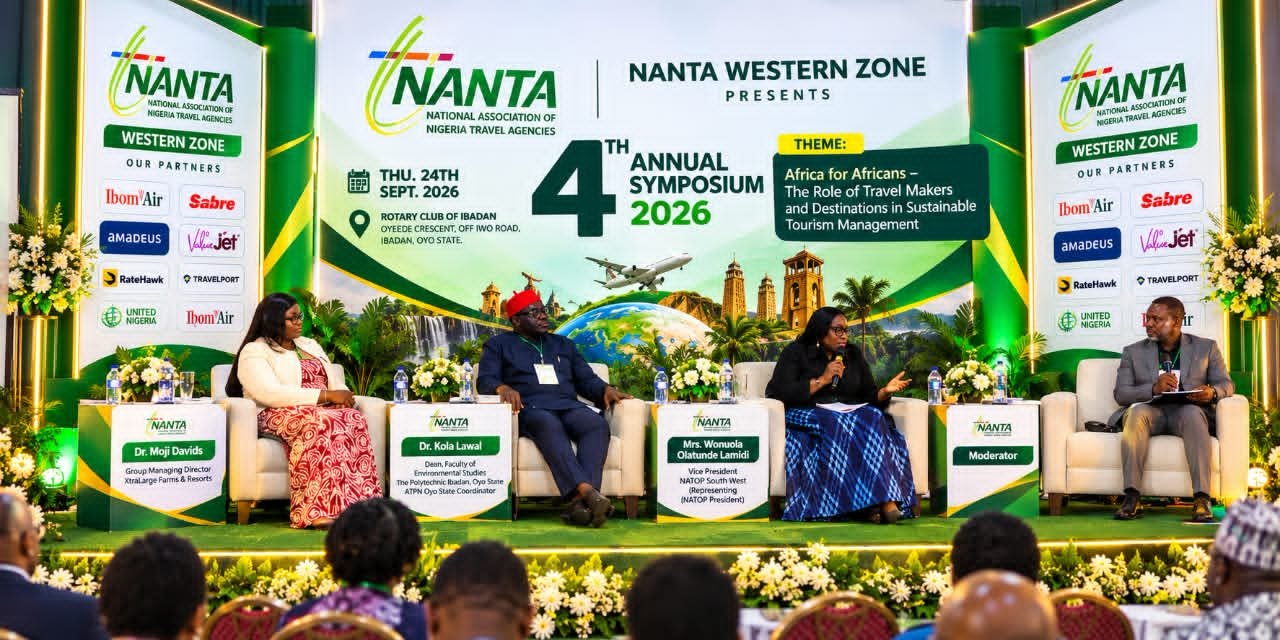
The stakeholders made the call on Thursday at the 4th Annual Symposium of the National Association of Nigeria Travel Agencies (NANTA), Western Zone, held in Ibadan, Oyo State.
The symposium, themed “Africa for Africans: The Role of Policymakers and Tour Operators Towards Sustainable Destination Management, Growth and Development,” focused on unlocking the commercial potential of intra-African tourism and strengthening Africa’s tourism economy.

Delivering the keynote address, Professor Wasiu Adeyemo Babalola, Chairperson of the National Technical and Mirror Committee on Tourism and Related Services of the Standards Organisation of Nigeria (SON) and Director of the Africa Travel Commission (ATC), said Africa needed tourism systems that would make travel within the continent easier, safer and more affordable.
Babalola said Africa’s tourism potential could translate into sustainable economic growth only when Africans played a greater role in creating, owning, managing and consuming the continent’s tourism economy.
He stressed that “Africa for Africans” should not be interpreted as isolation from the rest of the world, but as stronger African participation in global tourism.
According to him, African countries need to develop tourism products and systems that facilitate intra-African travel while ensuring that greater tourism value is retained within African economies.
He identified poor connectivity as one of the major obstacles to tourism growth, calling for stronger intra-African air links, efficient airports, improved surface transportation and better passenger facilitation.
Babalola also highlighted the cost of travel, visa restrictions, accommodation, transfers, taxes and other charges as factors that could undermine destination competitiveness.
He urged governments to simplify and digitise visa processes, make requirements and fees transparent, and improve coordination among immigration, aviation, tourism and security agencies.
The tourism expert further called on policymakers to integrate tourism with aviation, transport, immigration, security, infrastructure, environmental and digital policies.
He challenged Nigerian states to move beyond merely possessing tourist attractions and become active destination managers by developing distinctive tourism propositions, marketable experiences, appropriate infrastructure and effective governance structures.
Describing tour operators as “destination architects,” Babalola said they determine what visitors see, where they spend their money, how long they stay and the stories they take home.
He urged operators to develop authentic experiences, involve local businesses and communities in tourism value chains and strengthen their capacity to manage risks and disruptions.
Babalola also called for greater attention to African travellers, noting that domestic and intra-African tourism could diversify demand and strengthen the resilience of destinations.
He identified business, events, religion, education, leisure, culture, sports and family travel as some of Nigeria’s major travel drivers, urging tourism operators to develop products that reflect African purchasing power and preferences.
“Africa must learn to discover Africa,” he said.
On technology, he said artificial intelligence could support itinerary design, translation, customer service, marketing, forecasting and personalisation in the travel industry, while professional judgement remained necessary for safety, cultural appropriateness and accountability.
He also advocated the transformation of tourism into a career industry through professional education, certification, digital and AI skills, apprenticeships, mentoring, entrepreneurship and career progression.
“Young people need more than jobs. They need careers,” he said.
Earlier, Vice President of NANTA Western Zone, Chief Olaleye Abiodun Ajibade, said the theme of the symposium was timely, particularly against the backdrop of rising global travel costs and increasing restrictions.
Ajibade said Africa had successfully marketed its destinations to the rest of the world but had not done enough to market the continent to Africans themselves.
He noted that despite Africa’s population of more than 1.4 billion people, intra-African travel remained relatively low, describing the situation as a major commercial gap requiring coordinated action.
He said Africa was not short of tourism products, citing cultural and historical landmarks, eco-tourism destinations, natural wonders, wildlife reserves, migration routes, trekking destinations and heritage sites across the continent.
According to him, the major challenges were weak regional integration, inadequate connectivity, restrictive visa policies and fragmented cross-border marketing.
Ajibade said the symposium was designed to move stakeholders from discussion to execution, with emphasis on sustainable destination management, commercial viability for tourism operators and policy and regulatory harmonisation.
He called for public-private collaboration to address visa constraints, aviation taxes and barriers to seamless regional connectivity.
Panel Identifies Barriers to Tourism Growth
The need for African governments and tourism stakeholders to look inward and deliberately promote inbound and intra-African tourism also dominated the panel session at the symposium.
The panel, moderated by Wale Olapade, Tourism Editor of the Nigerian Tribune, featured Dr Kola Lawal, Dean, Faculty of Environmental Studies, The Polytechnic Ibadan; Dr (Mrs.) Moji Davids, CEO, Xtralarge Farms and Resorts; and Mrs Wonuola Olatunde Lamidi, who represented the President of the National Association of Tour Operators (NATOP), Hajia Bolaji Mustapha.
The panellists examined various challenges serving as barriers to the growth and development of tourism in Africa, with emphasis on the need for stronger local participation, better destination promotion and improved systems for attracting and retaining African travellers.
They agreed that African countries and tourism stakeholders needed to look inward and create greater awareness among Africans about the tourism opportunities available within the continent.
The panellists stressed that Africa should not rely predominantly on international visitors to sustain its tourism industry, but should develop strategies capable of encouraging Africans to travel within their own countries and across the continent.
They also emphasised the need for stakeholders to move beyond merely discussing tourism development and take practical steps towards marketing, packaging and promoting African destinations.
The panel further highlighted the importance of collaboration among government agencies, travel agencies, tour operators, destination managers and other private-sector players in removing barriers that discourage travel within Africa.
Representing NANTA National President, Dr Yinka Folami, the association’s First Deputy National President, Mr Mustapha Muhammed, described “Africa for Africans” as a new direction for travel agencies and tour operators seeking to use their influence to promote African destinations.
Muhammed said Africa had moved beyond being merely a tourism destination, noting that the continent also possessed world-class facilities capable of attracting travellers.
He said the symposium provided an opportunity for industry actors to examine practical ways of promoting African destinations, particularly those in Nigeria.
He also highlighted the importance of destination management companies in providing seamless and convenient travel experiences for tourists.
While appreciating members of the Western Zone for their support during the last Annual General Meeting in Ibadan, Folami, through his representative, assured members of the association’s commitment to improving their welfare and strengthening trust within the organisation.
Also speaking, the Oyo State Commissioner for Tourism, Dr Wasiu Olatunbosun, represented by the Director of Planning, Research and Statistics, Mr A.O. Akinola, pledged the state government’s continued support and collaboration with NANTA.
The representative reaffirmed the importance of cooperation between government and tourism practitioners in developing the sector.
Similarly, Mrs Wonuola Olatunde Lamidi, Vice President, South-West, NATOP, who spoke on behalf of NATOP President, Hajia Bolaji Mustapha, urged tourism practitioners to change the narrative about African tourism by actively marketing destinations on the continent to Africans.
Lamidi said tour operators and travel agents should see Africa as a tourism product that could be packaged and sold to Africans, rather than focusing primarily on destinations outside the continent.
She stressed the need to move tourism beyond rhetoric and ensure that stakeholders actively market and promote African destinations.
Earlier in his keynote address, Babalola had identified 10 priorities for policymakers, including integrating tourism with aviation and infrastructure policy, reducing regulatory barriers, supporting intra-African connectivity, investing in destination infrastructure, improving tourism data, strengthening destination-management institutions, enhancing visitor protection, supporting local tourism enterprises, involving communities in tourism value chains and measuring tourism by value created rather than visitor numbers alone.
For tour operators and travel professionals, he urged them to understand destinations deeply, design experiences rather than simple itineraries, develop products for African travellers, diversify source markets, use technology responsibly, build relationships with communities and local businesses, and strengthen disruption-management capabilities.
Babalola said Nigeria has a large domestic tourism market and diverse assets spanning culture, cuisine, heritage, festivals, nature, creative industries and business events.
He said the strategic task was to convert these assets into tourism products that are market-ready, accessible, safe, measurable and sustainable.
“Nigeria is not short of tourism assets. The task is conversion,” he said.
The symposium was attended by tourism professionals, policymakers, travel agencies, tour operators, industry partners and other stakeholders.
Among those present were NANTA’s Second Deputy National President, Dr Olatokunbo Dagunduro; National Publicity Secretary, Otunba Babatunde Adesokan; members of the Board of Trustees Curator Museum of National unity Mrs Oriyomi Pamela Otuka and other industry leaders.
The event also featured contributions from tourism and hospitality experts, including Mr Ernest Kwaku Asiedu Gyekye, Board Chairman of Safari Valley Eco Resort, Ghana, as well as other industry stakeholders.
The stakeholders ultimately advocated a more integrated African tourism market where travellers can move across destinations with fewer barriers, local businesses benefit from tourism spending, communities participate in tourism value chains and Africa’s natural and cultural resources are sustainably managed.