

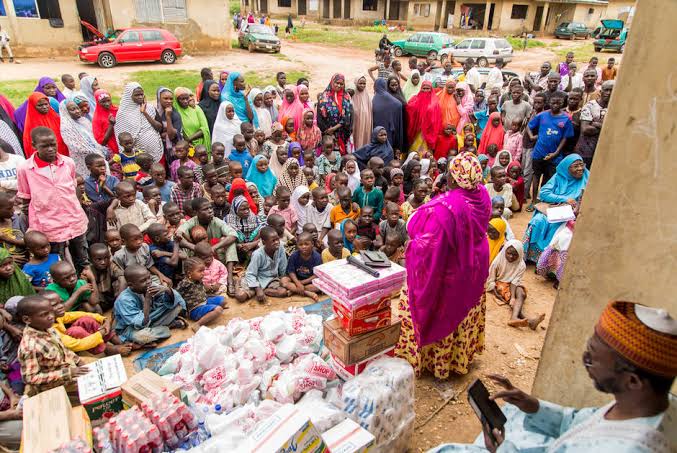
One of the critical problems resulting from the Bokoharam insurgency in northeastern Nigeria is the crisis of the Internally Displaced Persons (IDPs). The United Nations Refugee Agency (UNHCR) reported that more than 2.9 million people were displaced in the northeast as of December 2021.
The IDPs in the region move from one location to the other in search of safety, with some experiencing multiple displacements due to a convergence of conflicts. There are deaths and displacement along with loss of livelihood and supportive existential systems. They often experience human rights abuses and have many unmet needs with more adverse effects on vulnerable groups such as women, children and people living with disabilities.
In partnership with the global community, the Nigerian government has supported IDPs by building camps, supplying food, evacuating victims of insurgency from terror locations and signing the Kampala Convention to protect IDPs, among others. While many humanitarian and diplomatic interventions in Nigeria focus on livelihoods, the situation is rapidly moving towards IDP resettlement and reintegration. This shift, by necessity, requires a critical assessment of the data process protocols in the context of humanitarianism and displacement in Nigeria, as data is central to practical understanding and improved humanitarian protection systems.
Unfortunately, the data process necessary to provide effective and sustainable assistance to displaced persons in northeastern Nigeria is lacking. Reliable and valid humanitarian data are critical to designing and implementing practical and sustainable interventions. Such humanitarian data should be collected responsibly and ethically.
The need to collect humanitarian data using ethical standards is the focus of our research project with the Data and Displacement Research Team at the University of Warwick, United Kingdom and the University of Ibadan, Nigeria (www.warwick.ac.uk/datadisplacement). This project, led by Prof Vicki Squire, is funded by the UK Arts and Humanities Research Council and Foreign, Commonwealth and Development Office (AHRC\FCDO). The research involved 50 IDPs in five camps in Maiduguri, Borno state and 20 stakeholders and practitioners from 2021 to 2022. We further explore this issue in our report entitled Humanitarian Crises and Internally Displaced Persons in Nigeria: A Situation Analysis (Olufunke Fayehun and Olayinka Akanle 2022).
So far, our work shows that the humanitarian data process in northeastern Nigeria faces several challenges. First, personnel, technological and infrastructural gaps affect the coherence of data storage and handling processes. Data banks are available but are spread across divergent institutions and actors, generating reliability and systematization issues. Second, there are procedural and administrative obstacles in defining vulnerability. These created significant irregularities in the classifications and identifications of the most vulnerable IDPs in the camps. Third, engagement with IDP communities has been a challenge. In other words, those who collect data fail to effectively engage affected IDP communities in the production and use of data. The IDPs reported that they had at one time or the other given out their data to different organisations, but did not know what the data collected was used for or why it was requested. Fourth, and most crucial, is the challenge of inconsistency or limited application of ethical systems in data collection, storage, sharing and utilization. Full information disclosure and comprehension by IDPs often appear to be neglected in the data collection.
How do we improve the living conditions of Internally displaced persons in northeast Nigeria? We must enhance technological and infrastructural facilities. Rigourous capacity building must be pursued within and outside the camps to aid data collection, storage and utilization performances. We must also advance understanding and build consensus around the multiple vulnerabilities in IDP camps. At the core of all these is the need to appreciate the necessity of ethical-data-driven humanitarian practices for efficiency, effectiveness, and sustainability. This process must involve a commitment to improving IDP data literacies and access as well as reinforcing and institutionalizing ethical systems and values in collecting data from IDPs in camps and urban settings.
Ethical data collection and management processes are central to improving sustainable humanitarian assistance to displaced populations. The Nigerian government and critical stakeholders in the humanitarian corridors must review and implement appropriate policies to improve the living conditions of the IDPs. Further, collecting ethical qualitative data can ensure an understanding of the social context through which they live. Through this, we can know how displaced populations move, the challenges confronting them, and plan adequately for unintended consequences that such movement may cause.
Moreover, the humanitarian data process must adhere to ethical principles such as humanity (considering their sufferings and ensuring their dignity), neutrality (data collectors must should not be politically motivated), impartiality (there should be no bias based on sex, religion, ethnicity or age), and independence (humanitarian organizations accessing such data must be free from social, political, economic and military issues which inhibit their services when needed).
Safe, ethical and effective humanitarian data management will ensure that issues uncovered by the data will bring out evidence-based interventions. Adhering and committing to a responsible and ethical humanitarian data process will improve the lives of IDPs in northeast Nigeria.

Dr Fayehun is Associate Professor at the Department of Sociology, Univesity of Ibadan