
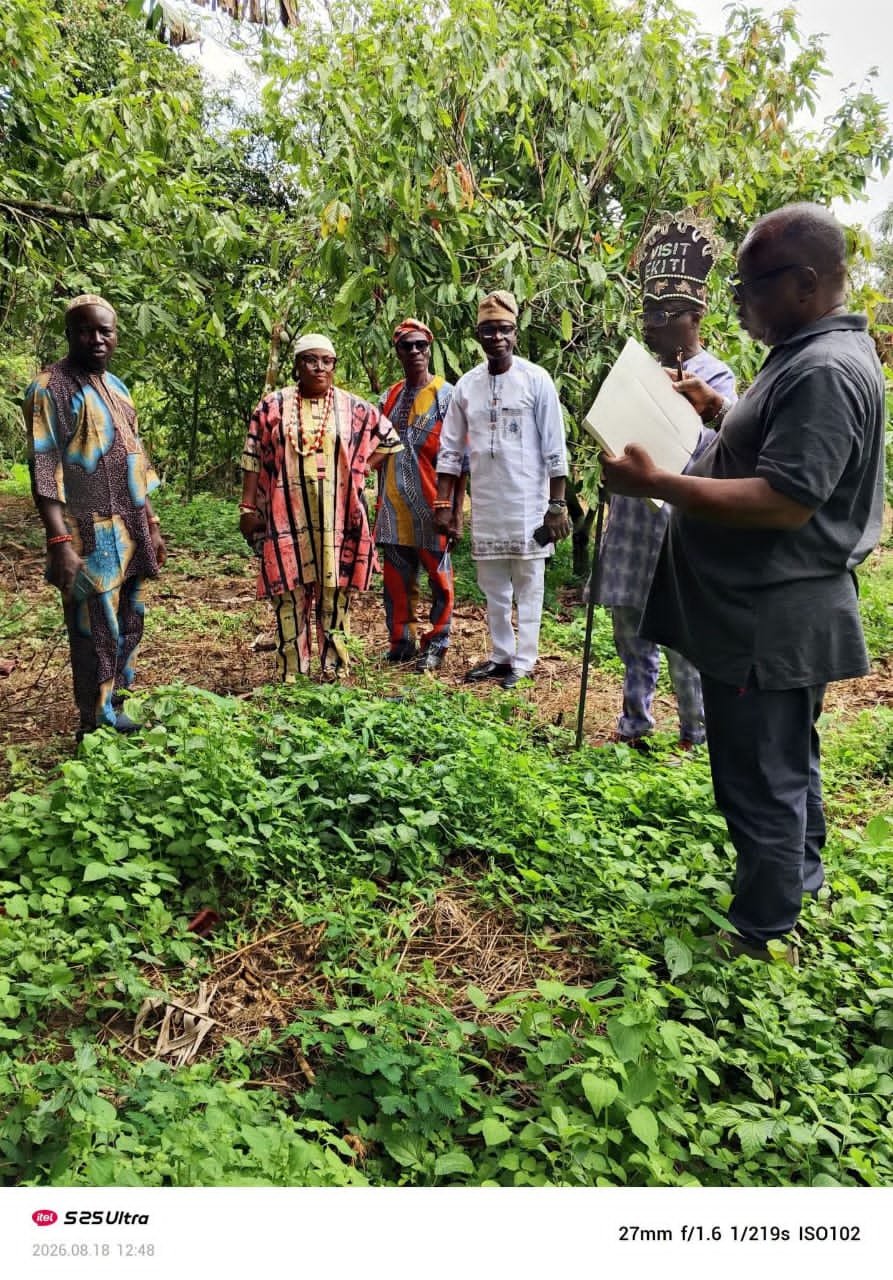
Archaeologists ground-truth satellite-mapped formations as Regent Sherifat Owolabi Adeyemi leads experts to heritage site
By Victor Ogundipe


Ekiti State may have uncovered another potentially significant heritage-tourism asset following the physical identification of unusual landscape formations previously detected through satellite mapping in Aramoko-Ekiti.

The discovery followed a field investigation by archaeologists and heritage researchers from the Museum of West African Art (MOWAA), Benin City, in collaboration with the Ekiti State Bureau of Tourism Development and the Ekiti Biodiversity Survey Project.
The team comprising Dr. Opajide Segun and Mr. A. Uranta Opuada of MOWAA, alongside Mr. Bamidele Joseph of the Ekiti Biodiversity Survey Project, had earlier identified intriguing formations around Aramoko through satellite imagery.
Following the findings, the Director-General of the Ekiti State Bureau of Tourism Development, Wale Ojo-Lanre, facilitated a physical inspection of the locations to determine whether the features observed remotely existed on the ground.
The investigation confirmed that corresponding physical landscape features are present at the identified locations.
The exercise, known as ground-truthing, involves physically verifying features initially identified through satellite imagery or other remote-sensing technologies.
However, the archaeologists cautioned that further scientific investigations would be required to establish the age, origin, extent and historical function of the formations.
The features could potentially represent an ancient moat, defensive earthwork, historic settlement boundary or another form of human-modified landscape, but the researchers stressed that no definitive conclusion could be reached until detailed archaeological studies are conducted.
Before proceeding to Aramoko, the delegation visited the Ekiti State Commissioner for Arts, Culture and Creative Economy, Prof. Rasaki Ojo Bakare, who is an indigene of the community.
Bakare expressed delight at the development, describing it as a welcome initiative capable of opening a new chapter in the documentation and promotion of Aramoko’s cultural heritage.
He noted that Aramoko possesses several cultural and historical resources that remain largely undocumented and insufficiently exposed, adding that professional archaeological research could help identify and preserve such assets for future generations.
In Aramoko, the delegation was received by the Regent of Aramoko-Ekiti, Regent Sherifat Owolabi Adeyemi, alongside chiefs and other traditional stakeholders.
The Regent subsequently led the archaeologists and Ojo-Lanre to locations associated with the formations earlier identified through satellite imagery.
The researchers also held extensive discussions with the Regent and chiefs, during which they explained the purpose of the investigation and the importance of combining archaeological techniques with oral traditions, community memory and indigenous knowledge.
The traditional authorities, in turn, provided historical information about Aramoko and its landscape which could assist the researchers in their subsequent investigations.
The MOWAA team indicated that the preliminary field visit would be followed by further work, potentially including detailed mapping, documentation, oral-history research and additional archaeological studies.
The experts also commended Ojo-Lanre for his proactive response to the satellite findings and for facilitating collaboration among the researchers, government, traditional institution and the community.
Speaking on the development, Ojo-Lanre described it as another positive development for tourism in Ekiti State.
He said the physical confirmation of the satellite-mapped features provided a tangible basis for further scientific investigation, while cautioning against reaching premature conclusions about their historical significance.
According to him, Ekiti’s tourism development should go beyond conventional attractions to include archaeology, ancient settlements, historic landscapes, oral traditions and other cultural resources.
He noted that if subsequent investigations establish significant archaeological and historical value, Aramoko could potentially become a destination for archaeological tourism, heritage tourism, academic research and educational excursions.
Such development, he added, could create economic opportunities for residents through tour guiding, transportation, accommodation, food services, arts, crafts and other tourism-related activities.
Ojo-Lanre said the initiative aligns with the administration’s broader efforts to identify, preserve and promote Ekiti State’s natural, cultural and historical resources.
The Bureau stressed that the next phase should focus on scientific investigation, professional documentation, conservation and sustained community participation.
For Aramoko, the discovery could mark the beginning of renewed efforts to document and promote its ancient history, while for Ekiti State, it represents another potential addition to its growing heritage-tourism portfolio.