
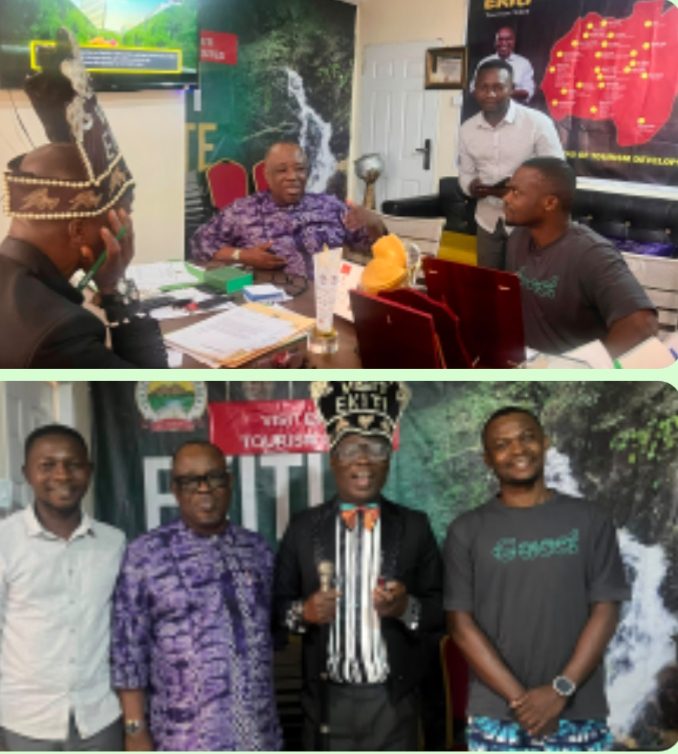
A team of archaeologists and heritage researchers has arrived in Ekiti State for a preliminary heritage reconnaissance and investigation of potential historic earthworks identified around Aramoko-Ekiti.


The visiting team comprises Mr. A. Uranta Opuada and Dr. Opajide Segun of the Museum of West African Art (MOWAA), Benin City, as well as Mr. Bamidele Joseph of the Ekiti Biodiversity Survey Project.

The experts are collaborating with the Ekiti State Bureau of Tourism Development to undertake preliminary ground-truthing of formations observed around Aramoko that may be of archaeological and historical significance.
As part of the exercise, the team will on Tuesday, August 18, 2026, visit Aramoko-Ekiti, where it will first pay a courtesy visit to the Regent, Sherifat Adeyemi Owolabi, and interact with traditional chiefs and other relevant community stakeholders before proceeding to inspect the areas of interest.
The visit will enable the researchers to compare satellite observations with physical features on the ground, obtain relevant oral and historical accounts from the community and determine whether the formations warrant more detailed archaeological investigation.
The Director-General of the Ekiti State Bureau of Tourism Development, Wale Ojo-Lanre, Esq., described the exercise as an important step towards identifying, documenting and preserving aspects of Ekiti’s heritage that may have remained hidden or insufficiently studied for generations.
According to him, the exercise is significant because Ekiti’s tourism potential extends beyond its renowned waterfalls, mountains, festivals and resorts to include archaeology, ancient settlements, traditional knowledge, historical landscapes and the footprints of earlier generations.
“This is essentially a preliminary heritage investigation. We are not jumping to conclusions or proclaiming an archaeological discovery before scientific verification.
“What we have is an indication from experts that certain formations around Aramoko deserve closer professional examination. The responsible thing to do is to bring the experts to the ground, engage the custodians of the community’s history and allow science, archaeology and indigenous knowledge to guide us.”
Ojo-Lanre stated that if the earthworks are eventually established as historically significant, the discovery could introduce a completely new product to Ekiti’s tourism portfolio and position Aramoko as a destination for archaeological, heritage, educational and research tourism.
He said the initiative complements the vision of the administration of Governor Biodun Abayomi Oyebanji to diversify Ekiti’s tourism offerings by identifying and developing the state’s cultural, historical, natural and creative assets for sustainable economic benefits.
The Bureau noted that a properly researched heritage site could create opportunities for academic research, school excursions, heritage interpretation, local tour guiding, conservation employment, community enterprises, hospitality services and increased visitor traffic.
It stressed, however, that community participation would remain fundamental to any future development arising from the investigation.
According to the Bureau, the Regent, traditional institution, community elders and other custodians of Aramoko’s history will be crucial in providing oral traditions and local knowledge that may assist researchers in understanding the origin, function and historical context of the formations.
Following the preliminary reconnaissance, the experts are expected to advise on whether further work should include detailed mapping, archaeological surveys, documentation of oral traditions, conservation assessment and other scientific studies, subject to relevant regulatory and professional requirements.
The Bureau maintained that the ultimate objective is not merely to identify another tourism attraction, but to ensure that any important heritage resource discovered in the state is professionally documented, protected, conserved and sustainably integrated into the tourism economy for the benefit of present and future generations.
For Ekiti State, the Aramoko exercise could therefore mark the beginning of an exciting new journey—from what lies beneath the soil to what could become a major window into the history, civilisation and tourism future of the state.