
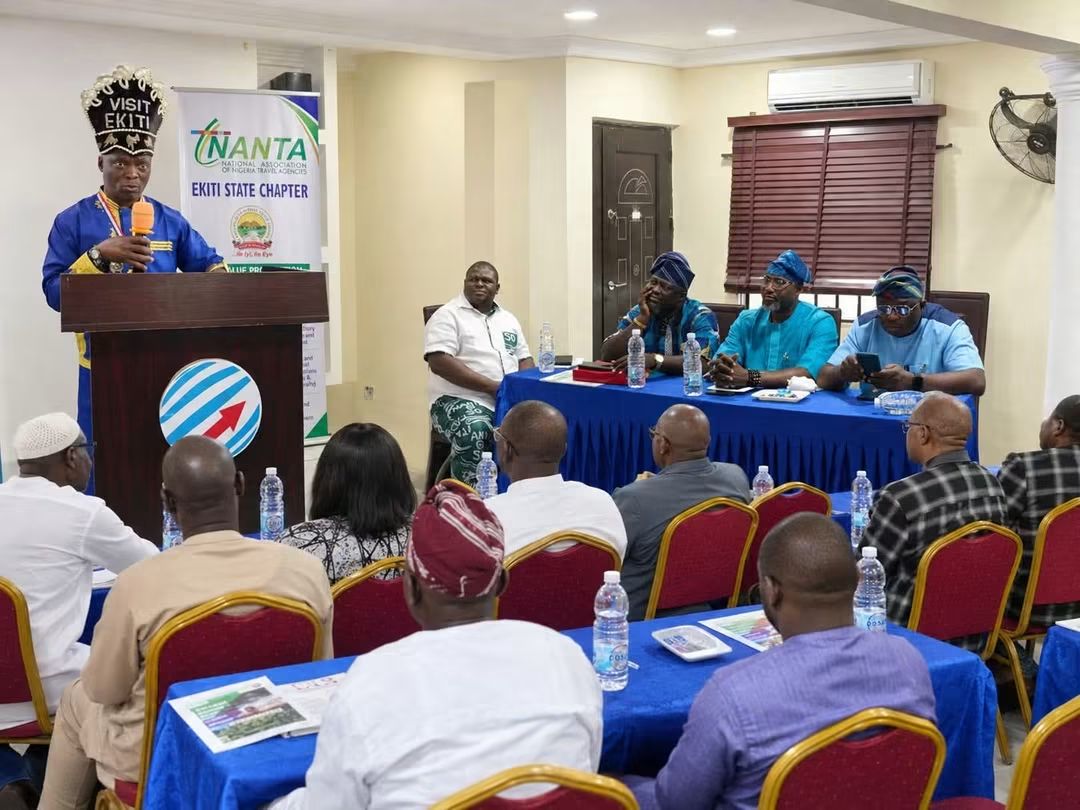
The Director-General of the Ekiti State Bureau of Tourism Development, Barrister Wale Ojo-Lanre, has called on travel agencies in Nigeria and across Africa to move beyond ticketing and take on a more strategic role in destination marketing, regional collaboration, and tourism development.


He made the call in Ado-Ekiti while delivering a keynote address titled “Strategic Partnership for Africa’s Tourism Future” at the inauguration of the Ekiti State Chapter of the National Association of Nigeria Travel Agencies (NANTA).

Ojo-Lanre said Africa’s tourism industry cannot thrive through isolated efforts, stressing that stakeholders must build strong partnerships capable of converting the continent’s tourism assets into economic value.
According to him, Africa is richly endowed with cultural heritage, natural landscapes, festivals, and historical sites, but has continued to treat tourism more as potential than as a fully harnessed economic sector.
He said the major challenge was not a lack of attractions but the fragmentation of the tourism value chain, where aviation, hospitality, travel agencies, transport operators, security agencies, and host communities often operate independently.
“Aviation has moved on its own. Hospitality has moved on its own. Travel agencies have operated independently… The era of the lone ranger is dead,” he declared.
He urged travel agencies to redefine their roles, describing them as “destination interpreters” and key connectors within the tourism ecosystem rather than mere ticket sellers.
Ojo-Lanre also stressed the need for deeper intra-African tourism integration, lamenting that African countries still focus largely on promoting themselves rather than collectively marketing the continent.
“South Africa sells South Africa. Kenya sells Kenya. Ghana sells Ghana. But Africa has not yet mastered the art of selling Africa to Africans,” he said.
He called for the development of seamless travel networks across the continent, noting that it should be easier for Africans to travel between African countries than to destinations outside the continent.
The tourism chief also urged continental bodies such as UN Tourism and the Africa Travel Association to strengthen regional tourism corridors, joint marketing, and policy harmonisation.
He further appealed to the Federation of Tourism Associations of Nigeria (FTAN) to expand its outlook beyond national borders and promote stronger African tourism linkages.
On Ekiti State tourism, Ojo-Lanre said the sector was experiencing renewed momentum under the administration of Biodun Abayomi Oyebanji, with several tourism sites being repositioned for visibility and investment.
He listed attractions such as Ikogosi Warm Springs, Arinta Waterfalls, Oke Sagbonke in Efon-Alaaye, Ugele Rock Shelter in Ikere-Ekiti, Abanijorin Rock in Iyin-Ekiti, and the Source of Osun River in Igede-Ekiti.
Ojo-Lanre also challenged the newly inaugurated NANTA Ekiti executives to collaborate with the state government in developing tourism packages such as weekend getaways, heritage tours, student excursions, and cultural and adventure experiences.
He emphasized that travel agencies must shift from “ticketing consciousness to destination consciousness,” urging them to actively promote local tourism assets.
“Nigerian tourism must not remain locked within Nigerian borders. We must export our culture, import experiences, and build reciprocal tourism flows,” he said.
He assured that the Ekiti State Bureau of Tourism Development would continue to work with stakeholders across the tourism value chain to transform tourism into a driver of economic growth.
The event ended with a call for stronger collaboration among government agencies, private operators, and community stakeholders to reposition Africa’s tourism industry for sustainable development.