There is a fundamental difference between acknowledging a government’s achievements and converting every government project into a political campaign for re-election. The article titled “Oba Ladoja’s ‘Retaliation’: How Bold Projects Are Securing Tinubu’s 2027 Mandate” written by Dr.Yinka Folahan appears to blur that important distinction.

The statement attributed to the Olubadan should not be presented as an automatic declaration that the entire people of Oyo State have decided to vote for President Bola Ahmed Tinubu in 2027. A traditional ruler may express his personal political opinion, but that opinion cannot substitute for the independent choices of millions of voters.

Oyo State occupies a unique position in the political history of the South-West. It is the state of the late Chief Ladoke Akintola, Late Chief Meredith Adisa Akinloye, Late Chief Lamidi Ariyibi Adedibu ,Late Chief Adegoke Adelabu Penkelemesi amongst others. This is not a state of political neophytes. Oyo people are politically conscious and capable of assessing governments and making independent electoral decisions. It is the State where the father, mother and children casts their votes across party lines .
This political maturity is also evident in the way the people evaluate infrastructure projects. They are interested not merely in flag-offs and ceremonies, but in funding, execution, quality, completion and impact.
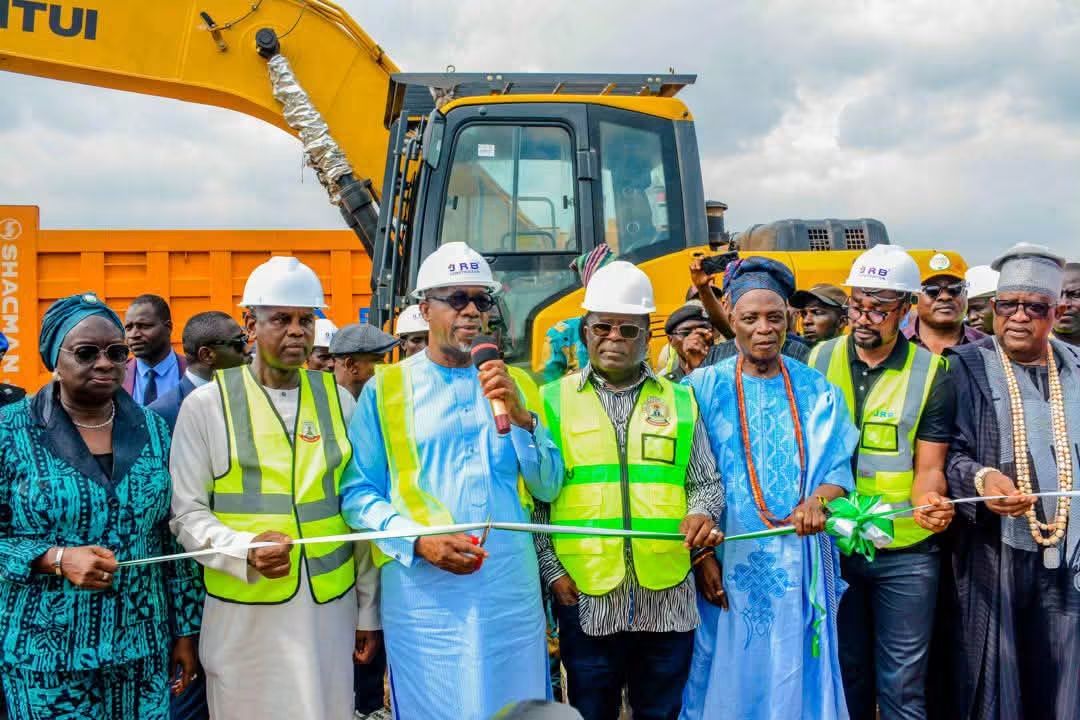
The Ibadan–Ijebu-Ode Road is undoubtedly important to the economic development of the South-West. However, a flag-off is not the same as a completed road. Oyo people have witnessed federal projects being announced, inaugurated and sometimes re-inaugurated, only for implementation to stall.
The Oyo–Ogbomoso road remains a compelling example. While Nigerians welcome new infrastructure, they are entitled to ask why existing major projects have not been completed before new ones are celebrated. The same question applies to the Oyo Town Circular Road.
Consequently, some people in Oyo State are beginning to perceive these fresh road flag-offs as “Greek gifts” projects being presented with the hope of persuading voters to support President Tinubu again in 2027. Their curiosity is understandable. Why is a state that gave President Tinubu one of the highest vote margins in the South-West now witnessing renewed federal attention to major road projects as another election approaches? The Federal Government deserves credit for every project it genuinely delivers, but citizens must be allowed to question the timing and sustainability of such interventions.
It is equally important to acknowledge the role of the Oyo State Government under Governor Seyi Makinde in the resuscitation of the Ladoke Akintola Airport, which had suffered prolonged neglect. Rather than waiting indefinitely for federal intervention, the state government took steps to restore the airport and improve its economic relevance. This is significant because the Oyo State Government has, on several occasions, had to stand in where federal intervention was not forthcoming. This history makes it difficult for many residents to accept every new federal project announcement without asking whether it represents genuine long-term development or an electoral strategy ahead of 2027.
The same caution should apply to Ajaokuta Steel. A 20-year gas supply agreement may be an important step, but an agreement is not the same as a fully operational steel plant. Nigerians deserve to see production, jobs, industrial output and measurable economic benefits before declaring the decades-long problem solved.
It is therefore premature to claim that these developments have already “secured” President Tinubu’s 2027 mandate. Elections are not rewards for ceremonies, headlines or endorsements. They are judgments based on citizens’ experiences with employment, purchasing power, security, infrastructure, cost of living, governance and accountability.
If the Tinubu administration believes its achievements will earn it another mandate, it should allow Nigerians to make that judgment freely. There is no need to suggest that traditional institutions or political commentators have already spoken on behalf of the electorates.
Oyo State voters do not need anyone to tell them how to “retaliate” in 2027. They will decide for themselves. They will examine the promises, assess the projects, compare performance with expectations and ultimately express their judgment at the ballot box.
The people of Oyo State are watching, asking questions and, ultimately, they will decide.