
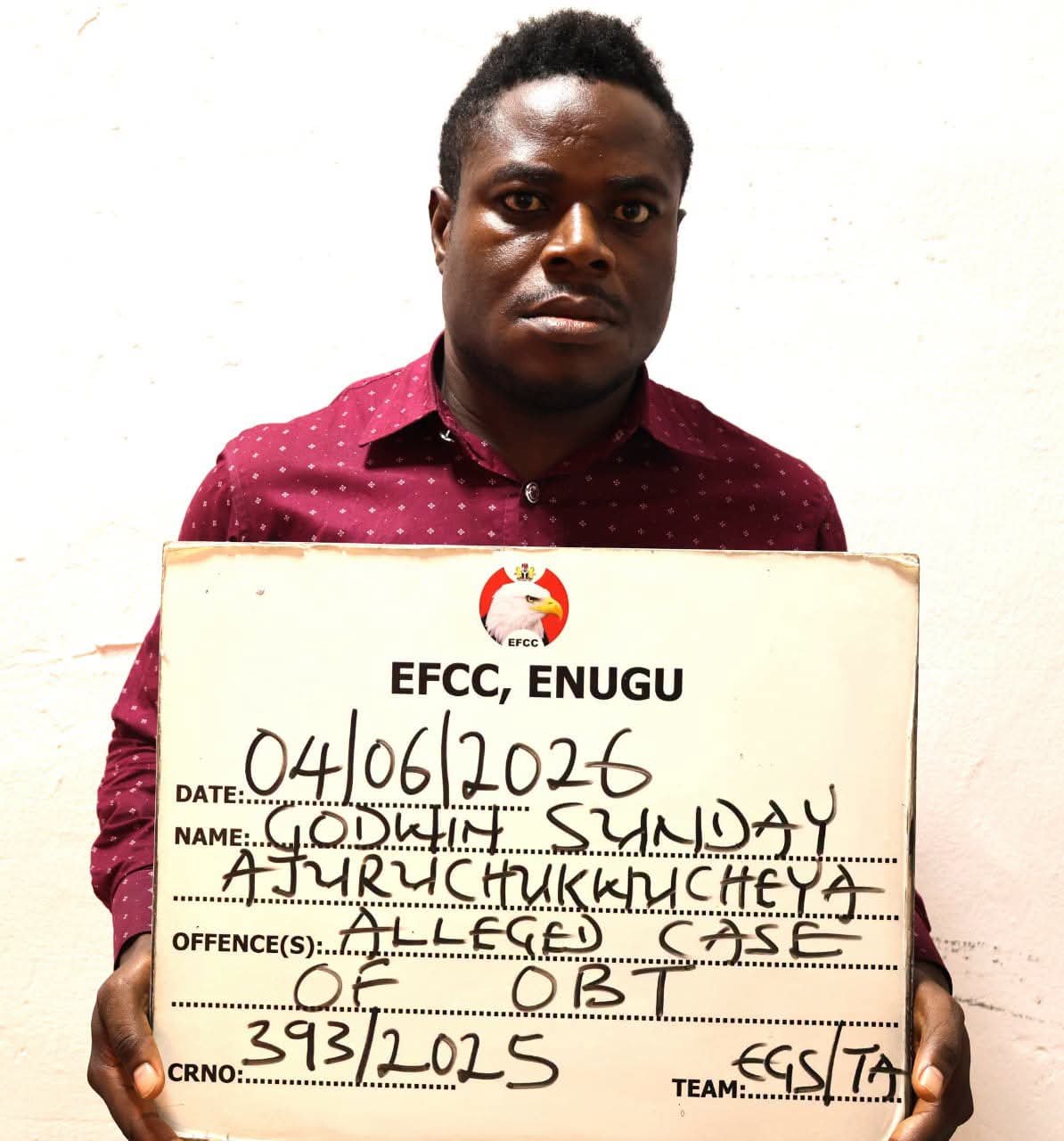
The Enugu Zonal Directorate of the Economic and Financial Crimes Commission (EFCC) has secured the conviction of self-acclaimed cleric, Godwin Sunday Ajuluchukwucheya, also known as Prophet Sunday Koboko, for defrauding members of his church of N136.4 million through fake miracles and a fraudulent investment scheme.


Justice H. O. Eya of the Enugu State High Court, sitting in Independence Layout, convicted the defendant after he pleaded guilty to a two-count charge bordering on obtaining by false pretence and stealing.

According to the EFCC, Ajuluchukwucheya fraudulently obtained N136,436,000 from unsuspecting church members between 2023 and February 2025 by falsely claiming he had won N30 billion in Baba Ijebu Lotto and promising investors huge returns based on their contributions.
The anti-graft agency said the convict also deceived victims with claims of possessing supernatural powers.
One of the petitioners, Mrs. Ngene Nkiruka Jane, told investigators that the self-acclaimed prophet convinced her he could resurrect her late husband. She subsequently paid N6.7 million for the purported resurrection and participation in the fraudulent investment scheme.
Another victim, Okey Uwakwe, alleged that the convict collected N6.231 million from him after claiming he could spiritually compel his brother, who had been living abroad since 1997, to return home.
The EFCC further revealed that investigations uncovered several other victims who reported being defrauded by the convict. He allegedly sold so-called prosperity items, including “miracle stickers,” “spiritual dragon,” and “Holy Ghost Thunder,” claiming they possessed supernatural powers capable of bringing wealth and breakthroughs.
Following his guilty plea, EFCC counsel, Assistant Commander of the EFCC (ACE II), Rotimi Ajobiewe, urged the court to convict and sentence him.
Justice Eya sentenced Ajuluchukwucheya to one year imprisonment with an option of a N500,000 fine.
The court also ordered the forfeiture of his landed property, covered by a Customary Certificate of Occupancy dated July 25, 1989, to the Federal Government through the EFCC. The property is to be sold, with the proceeds used to compensate victims of the fraud.
The offences contravene Section 1(1)(a) of the Advance Fee Fraud and Other Fraud Related Offences Act, 2006, and are punishable under Section 1(3) of the same Act.