
I will start this article of mine with a quotation from the ancient Roman statesman, Cicero, who said, “Gratitude is not only the greatest of virtues but the parent of all others.”
In the context of leadership and governance, if a man has performed well, he must not only be applauded, praised, commended, and acknowledged—he must and should be retained, supported, and encouraged to do even more.

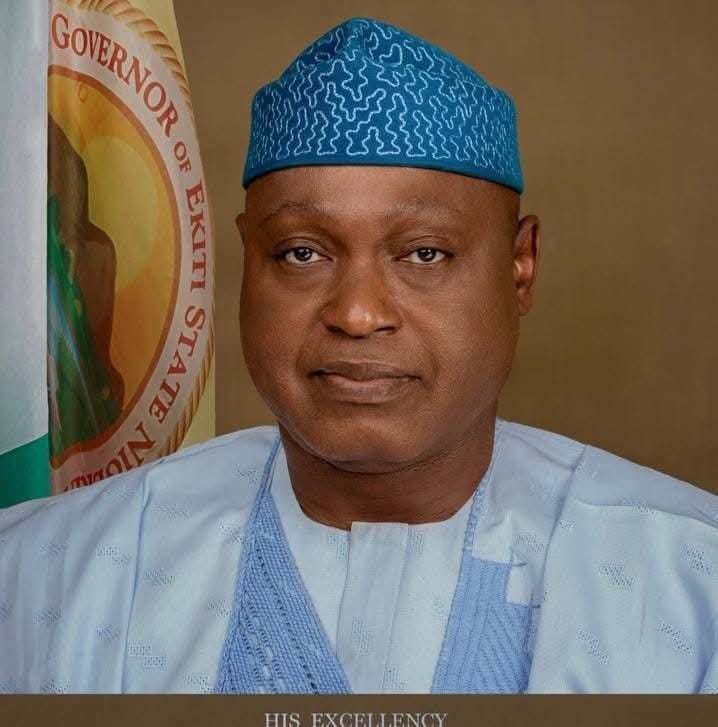
Governor Biodun Abayomi Oyebanji, the unassuming statesman from Ikogosi-Ekiti, is a classic reflection of what the 16th American President, Abraham Lincoln, once typified: “Character is like a tree and reputation like a shadow.” His face may not dominate magazine covers, his voice may not be thunderous, but his works speak volumes—monumental and transformative. Like an international leader who stunned the world when the least was expected of him, Oyebanji has, with modesty and method, done what Napoleon could not—especially in uniting Ekiti’s political class under one Pan-Ekiti vision.
His achievements in office revolve around six foundational pillars, with two overriding virtues: peacebuilding and continuity. Together, they form eight unimpeachable reasons why Oyebanji must be given another term of four years—to return in grace and continue his good work. Continuity is the mantra!
1. In Pure Governance: He Has Practically, Physically, and Graphically Planted the Architecture of Responsive and Secure Leadership
Governor Oyebanji has redefined governance in Ekiti through inclusiveness, transparency, and accountability. Through the Open Government Partnership (OGP), budget consultations with civil society groups, and citizen feedback mechanisms, he has institutionalized a government that listens.
He has also made security a bedrock of his leadership. Through consistent investment in surveillance, community policing support, and inter-agency coordination, Ekiti has been officially declared the safest state to live in Nigeria—a landmark recognition that has boosted investor confidence and citizen morale.
As John Maxwell puts it, “A leader is one who knows the way, goes the way, and shows the way.” Oyebanji has done exactly that—crafting a blueprint of people-first, safety-conscious governance.
2. In Infrastructure and Industrial Development: Governor Biodun Abayomi Oyebanji Is Skillfully and Methodically Building for Tomorrow
From rural road connectivity to urban renewal, Oyebanji’s infrastructural revolution is bold and strategic.
He has reconstructed critical roads across all 16 LGAs, completed two iconic Overhead Bridges to ease traffic congestion in Ado-Ekiti, and midwifed the near-completion of the Agro-Allied International Cargo Airport—a gateway that will position Ekiti as an agricultural export hub.
The state-of-the-art Bus Terminal, the Ado Ring Road project, and the launch of the Ekiti Independent Power Project (IPP) reflect a forward-thinking leader preparing his state for industrial takeoff.
Through the Ekiti Investment Promotion Agency (EKIPA), his reforms on Ease of Doing Business have attracted investors like Cavista Holdings, who are investing heavily in agro-processing and farm technology.
He builds not just bridges and roads—but the highways of prosperity.
3. His Knowledge Economy Vision Is Stimulating and Enchanting—Focusing on Cultivating the Mind as Capital
Education in Ekiti is not just a slogan under Oyebanji—it’s an economic strategy. Scholarships, digital education projects, improved WAEC ratings, and the resuscitation of technical education all point to a knowledge-driven agenda.
To paraphrase Nelson Mandela: “Education is the most powerful weapon you can use to change the world.” Oyebanji has wielded it wisely for Ekiti.
4. Governor Oyebanji’s Agriculture and Rural Development Stride Is Deep in the Dynamism of Contemporary Dictation—With the Drift to ‘From Subsistence to Agribusiness’
The Governor’s agricultural roadmap has shifted the narrative from hoe-and-cutlass to agribusiness. Initiatives like the Cluster Farmers Initiative, Anchor Borrowers Scheme, the World Bank-supported Rural Access and Agricultural Marketing Project (RAAMP), and youth-driven agro-enterprises are turning the sector into a revenue spinner.
Through private partnerships, youth engagement, and access to market infrastructure—including the forthcoming airport—Ekiti’s farmers are being empowered as agripreneurs. He is restoring dignity to farming and ensuring food security.

5. In Health and Human Development, His Mantra Is: Health as a Right, Not a Privilege
From revitalized primary healthcare centres to the expansion of the Health Insurance Scheme and recruitment of medical personnel, Oyebanji has taken health seriously. As Hippocrates said, “Wherever the art of medicine is loved, there is also a love of humanity.”
Ekiti is healthier and happier under his watch. His achievements in the health sector even inspired health professionals and associations in Ekiti to organize one of the largest crowd-pulling BAO endorsement rallies for his second term in Ado-Ekiti recently.
6. Arts, Culture and Tourism: Turning Hidden Treasures into Global Assets
Perhaps Oyebanji’s most revolutionary stride lies in tourism—a sector many governments merely pay lip service to. He revived and repositioned Ikogosi Warm Spring Resort through an innovative Public-Private Partnership (PPP), returning it to global reckoning.
The creation of the Ekiti State Bureau of Tourism Development institutionalized a dedicated framework for growth.
Under his watch, Ekiti has emerged as the most active and creative tourism state in Nigeria, earning national accolades. He midwifed the Ekiti Tourism Policy and the Tourism Development Master Plan—both firsts in the state’s history.
Most notably, Ekiti became the first state in Nigeria to engage the United Nations Tourism Organisation in producing its tourism policy—a bold, international move.
The Vice President of Nigeria even shared the “Visit Ekiti” logo on his personal media platform—an extraordinary moment of national and global endorsement.
7. In Peacebuilding: Governor Oyebanji Has Been Described as a Phenomenon for His Wisdom and Sagacity in Uniting the Fathers of Ekiti Politics
No governor in the history of Ekiti has accomplished what Oyebanji has done in political reconciliation. He brought together, in unprecedented unity, all past governors—Otunba Niyi Adebayo, Ayo Fayose, Segun Oni, and Kayode Fayemi—despite their differing political pedigrees.
That iconic photograph of five living governors smiling in unity is a historic testament to Oyebanji’s emotional intelligence and leadership maturity.
8. Lastly, His Commitment to Continuity Has Been Able to Secure the Gains of Progress of His Predecessors in Office
Continuity in governance means safeguarding institutional memory, accelerating development without regression, and consolidating established progress.
Governor Oyebanji has shown fidelity to the projects and legacies of his predecessors—especially in finalizing roads, schools, and industrial initiatives started by Governor Fayemi.
He epitomizes the Yoruba adage: “A kii fi ọwọ otun da ile, a fi ti osi bo.” (One must not abandon a stable foundation.)
Governor Biodun Abayomi Oyebanji is not merely governing; he is leading. With quiet competence, intellectual depth, and strategic clarity, he is redefining what it means to govern a progressive, proud people.
He has planted six seeds of advancement which he has tended with painstaking diligence, seriousness of purpose, and the herculean audacity of an Ekiti man. With agrarian precision, he has monitored and nurtured these seeds for four years.
As the philosopher Lao Tzu once said, “The best leaders are those the people hardly know exist… When the best leader’s work is done, the people say, ‘We did it ourselves.’”
It is only rational for progressive minds to allow him to continue—to nurture these seeds to blossom, fruit, and multiply for another four years.
Therefore, his endorsement and subsequent re-election should not merely be a political decision—it should be a reward for performance, a validation of peacebuilding, and a reaffirmation of continuity.
Ekiti has found a stabilizer in Oyebanji. Let us not trade gold for glitter. Let us move forward.
Let BAO 4+4 = 8.
A fait accompli.
BAO—Forward Ever!
God bless Ekiti State.
Wale Ojo-Lanre, Esq., is a journalist and the Director General, Ekiti State Bureau of Tourism Development.