

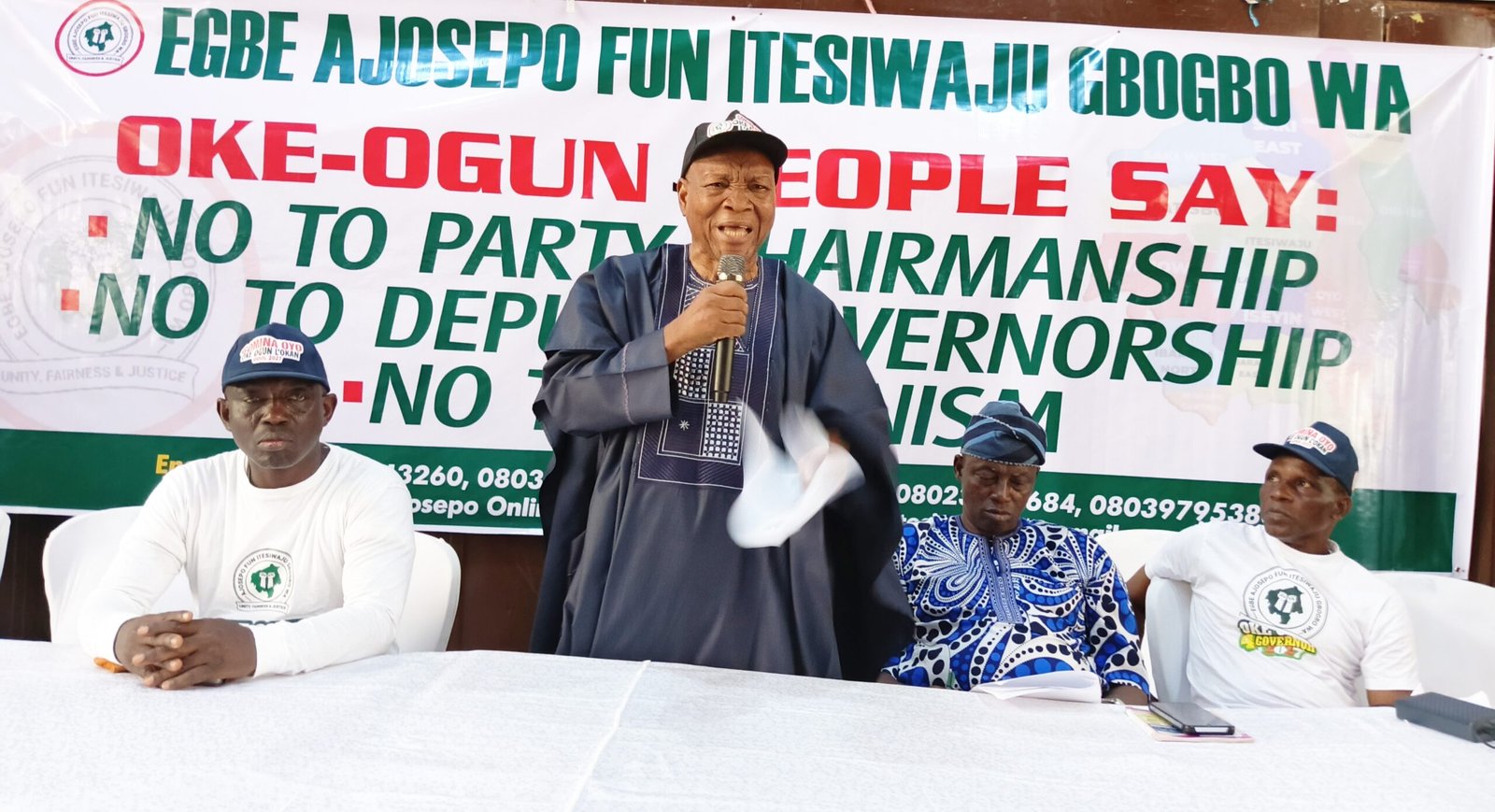
A prominent advocacy group, Ẹgbẹ́ Àjọṣepọ̀ Fún Ìtẹsiwájú Gbogbo Wa, has rejected the zoning of party chairmanship positions to the Òkèògùn region, describing such offers as “political tokenism” designed to block the zone’s path to the Agodi Government House in 2027.
Addressing journalists at a press briefing in Ibadan, the group in a paper signed by Engr. Dauda Olaifa (National Chairman) and Pst. Favour Adéwọyin (National Secretary) and read by Chief Muda Ogunsola declared that the era of accepting what it termed “consolation prizes” was over, insisting that Òkèògùn would settle for nothing less than the governorship of Oyo State in the next general election.
The group argued that historical developments since 1999 reveal a pattern of using party chairmanship positions to pacify Òkèògùn while executive power remains concentrated in other zones.
“Our position is clear: No to Deputy Governorship, no to Party Chairmanship. Yes to the Governorship of Oyo State in 2027,” a spokesperson of the movement stated
“Once a lesser political office is zoned to a particular region, the prospects of that same region subsequently producing the Governor become significantly diminished — if not completely foreclosed.”
The group backed its claims with a historical review of party leadership in the state, noting that Òkèògùn has produced several party chairmen across political parties and five deputy governors, yet has never occupied the top seat at Agodi.
In a move likely to stir political debate, the group formally disclaimed some prominent figures from the region, stating that they lacked the mandate to negotiate on behalf of Òkèògùn if such negotiations undermine its governorship aspiration.
According to the group, the true representatives of Òkèògùn are the grassroots voters who are now demanding equity and fairness in the state’s political arrangement.

The movement appealed to other zones — Ìbàràpá, Ọ̀yọ́, Ògbómọ̀ṣọ́ and Ìbàdàn — to support what it described as a just and equitable agitation, anchored on the Federal Character principle enshrined in the 1999 Constitution.
In a direct appeal to traditional and political leaders in Ibadan, the group called on the Olubadan of Ibadan, Rashidi Ladoja, and other prominent Ibadan stakeholders to support the agitation.
It urged them to see the 2027 governorship contest as an opportunity to look beyond Ibadan in the interest of fairness, unity and balanced power rotation across the state.
“We stood by you in your season; we now look with confidence to your principled support in ours,” the group said, reminding Ibadan leaders of Òkèògùn’s longstanding loyalty and support for Ibadan-born governors.
They concluded with a three-point declaration: that Òkèògùn is next in line to produce the governor in 2027; that the struggle is one of justice and not rebellion or sectional interest; and that both the All Progressives Congress and the People’s Democratic Party should zone their 2027 governorship tickets to Òkèògùn to guarantee a sense of belonging for all regions of the state.
“We have competent hand and resources to lead the state, we have interviewed about seven people who have served at both local and international capacity and they are all available