

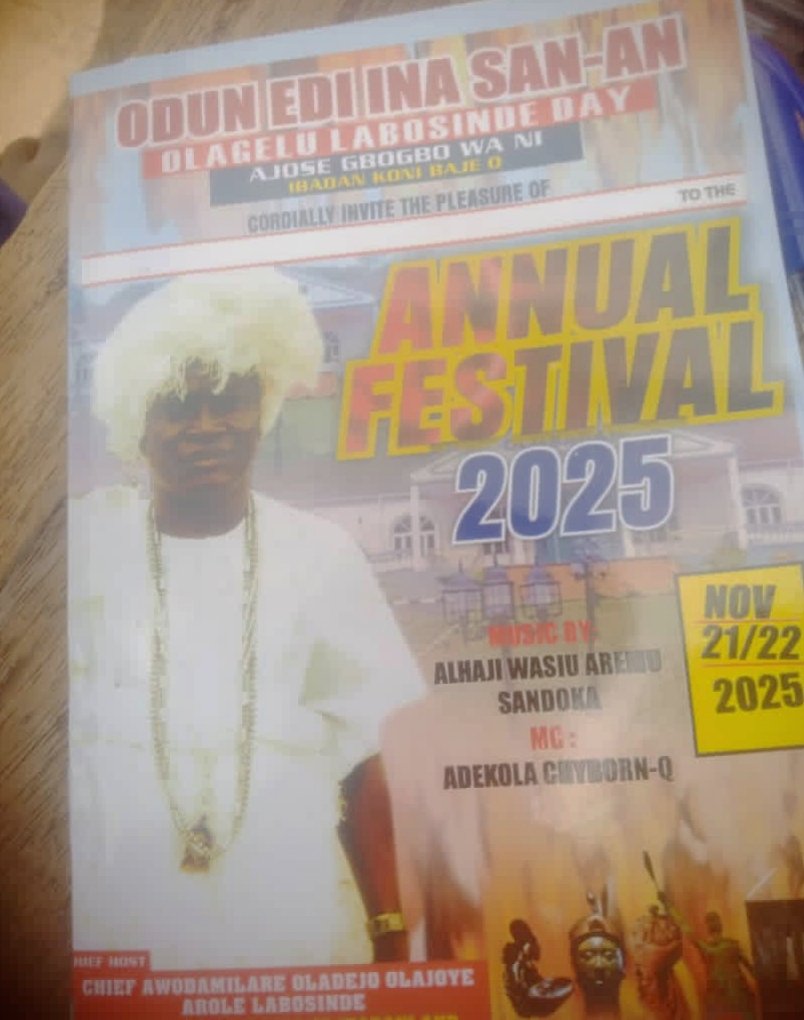
The Olagelu Labosinde family has announced the official commencement of activities for the 2025 Odun Edi Ina San-an Annual Festival, a revered cultural celebration deeply rooted in the traditions and heritage of Ibadanland.
The festival, which formally begins Sunday, November 15, 2025, will run through November 21 and 22, featuring a series of traditional rites and age-long rituals that define the identity of the Labosinde dynasty.

Regarded as one of the most symbolic cultural ceremonies of the lineage, the Odun Edi Ina San-an is often compared in significance to the Olojo Festival in Ile-Ife. Organizers describe it as a heritage event dedicated to preserving the legacy of the Olagelu Labosinde family, fostering unity, and strengthening communal bonds.
This year’s edition, themed around unity, culture, and communal progress, is expected to attract family members, traditional custodians, cultural enthusiasts, and residents from within and outside Ibadan. Organizers say the 2025 celebration is projected to be one of the most colourful in recent years.
Traditional rites commenced on Sunday with Ilagun, marking the official start of the festivities. On Friday, the sacred Ina Edi rite will be performed, during which the Tele (the custodian of the rite) will lead the symbolic procession to the Bode River, continuing an age-long spiritual ritual central to the festival.
The grand finale of the traditional observances will hold on Friday, November 21, leading into the main festival celebrations scheduled for November 21 and 22.
In addition to its cultural and spiritual significance, the festival will feature vibrant entertainment. Music will be provided by Alhaji Wasiu Aremu Sandoka, while Adekola Cityborn-Q will serve as the Master of Ceremonies.
The festival is hosted by Chief Awodamilare Oladejo Olajoye, the Arole Labosinde and a respected custodian of Ibadan’s traditional heritage.

With preparations in top gear, organizers say the 2025 Odun Edi Ina San-an Festival will once again highlight the enduring cultural richness of the Labosinde family and reinforce its historical importance in Ibadanland.