
There are some stories that are not immediately visible in public life. But they shape everything that comes after.
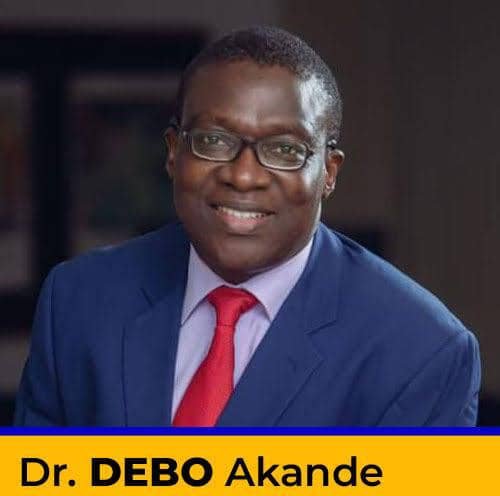
For many, the name Dr Debo Akande has only recently entered public conversation. What is less known is the journey that shaped the discipline behind the work.
In a recent interview, Dr Akande speaks to the journey that has led him down the path to where he has become a strategic name in the Oyo State conversation.

At the age of seventeen, he lost his father.
In that moment, a decision had to be made about responsibility. Resources were scarce. So, he and his elder brother, chose to step back. On his own part, he held off tertiary education for nearly a decade so that his younger siblings could have the opportunity to go to school first.
It was not an easy decision. But it was a defining one.
What followed was not a straight path.
He worked. He traded – selling bread in traffic and later working as a trainee clearing agent in NAHCO. He navigated life at a time when survival itself required focus and resilience.
But even then, there was a quiet discipline. A refusal to lose sight of something unfinished.
He continued to read, learn and prepare.
At one point, like many young Africans searching for opportunity, he attempted to cross into Europe through the desert.
It did not work.
But that experience became part of a deeper understanding of struggle, of risk, and of the realities many young people face when opportunity is not structured.
Eventually after nine years of wilderness, he found another path.
Through persistence and support, he gained admission to study International Development in the United Kingdom. Thus, returning to formal education with clarity and purpose.
Along the way, mentorship played a defining role.

Not always from older figures, but often from peers – individuals whose guidance and perspective helped shape decisions at critical moments.
That experience would later influence a strong belief:
That mentorship is not a luxury. Mentorship is a necessity in shaping the direction of young people.
Earlier influences also mattered.
From his father, and from his uncle who gave him the opportunity to work as a political clerk. This came early exposure to grassroots realities in the second republic years of the National Party of Nigeria (NPN) and third republic Social Democratic Party (SDP). This shaped an understanding of how people, structures and power interact in practice.
Years later, those lessons would prove useful in governance.
For example, during the COVID-19 period, while coordinating aspects of agricultural intervention in Oyo State, a situation emerged.
A distribution plan had been developed and vetted at the state level.
But at the local level, community stakeholders felt excluded.
The response was immediate… and forceful and his team was turned back.
It was a moment that could have ended the effort.
Instead, it became a lesson.
The approach was rethought.
Engagement was prioritised.
Conversations were held.
Local realities were acknowledged.
And when the team returned, they did so differently, with a structure that accommodated both the State’s objectives and the community’s expectations.
The outcome was not just successful distribution but restored alignment.
That pattern of stepping back, reassessing, and returning with a better approach reflects a deeper instinct.
An instinct to understand before acting
Over the years, this has also shaped a particular style of leadership.
One that does not remain distant from the work.
But one that shows up.
On the ground.
Across communities.
In real conditions.
It is estimated that over the past two decades, he has traversed over 75% of Oyo State, engaging with farmers through programmes involving his work at the International Institute of Tropical Agriculture (IITA) across Africa, Oyo State N-CARES and Livestock Productivity and Resilience Support Project (LPRES), engaging directly with people, systems and realities beyond the capital.
There is also a recognition that opportunity, when given, must be fully utilised.
The platform provided through the leadership of His Excellency, Engr. Seyi Makinde, created room to apply years of learning across different contexts.
And in that space, the work has reflected a consistent pattern of structure, engagement and execution.
Seen together, these experiences form something deeper than a résumé.
They reveal a process.
A gradual shaping of perspective… built through responsibility, experience, failure, mentorship and practice.
It is from this foundation that the work seen today emerges.
The result of years of preparation, often outside public view.
And perhaps that is the point.
Before systems are built… something else is built first.
Resilience.
Judgement.
Perspective.
Because in the end, systems are not just designed.
They are shaped by the experiences of the people who build them.
*Ajao sent this piece from Isale Oyo, Oyo,