

Odu’a Investment Company Limited (OICL) has reaffirmed its commitment to digital education and youth empowerment across Southwest Nigeria, with its Byte Busters Coding Clubs reaching more than 4,500 learners through 20 centres in 18 local government areas across the region. The company restated its commitment at the second edition of the Byte Busters Showcase 2026, held on Friday at the University of Ibadan International Conference Centre, Ibadan, where students demonstrated innovative technology projects addressing real-life challenges.


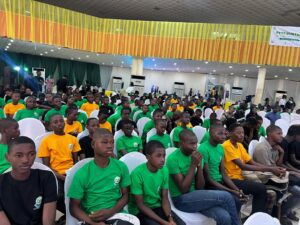

The showcase, organised under the Digital Education for Innovation and Economic Development (DEFINED) Project of the Odu’a Investment Foundation (OIF), brought together stakeholders in education, government, technology and the private sector to celebrate the creativity of young people and promote greater access to digital learning. Speaking at the event, OICL Group Chairman, Dr. Tola Kasali, said the company’s responsibility extended beyond business performance to include sustainable development and the empowerment of communities across its six owner states.
Kasali said commercial prosperity and social development were complementary responsibilities, stressing that the future of Southwest Nigeria depended on equipping young people with the knowledge and skills required to thrive in an increasingly technology-driven economy. He noted that digital education must go beyond basic computer literacy to develop critical thinking, collaboration, creativity and practical problem-solving abilities among students. According to him, Byte Busters represents an investment in human capital that will strengthen the region’s capacity for innovation and economic growth.
The OICL Group Managing Director, Abdulrahman Yinusa, described the showcase as a celebration of young people’s ingenuity and the opportunities created when they receive access to digital tools, guidance and practical learning. He said the Odu’a Investment Foundation was established as the company’s corporate social responsibility vehicle to deliver sustainable interventions in education, healthcare and youth development. Yinusa added that the DEFINED Project was designed to address disparities in access to digital education, particularly among students in public schools, by equipping them and their teachers with relevant skills for the future.
He explained that Byte Busters operates through after-school coding clubs in public secondary schools across the six Southwest states, exposing students to coding, artificial intelligence, computational thinking, digital creativity and technology-based problem-solving. According to him, the programme seeks not only to teach students how to use technology but also to empower them to develop solutions to challenges within their communities. He urged stakeholders to strengthen their collaboration with the Foundation to expand the programme’s reach and ensure that more young people benefit from digital education.
In his remarks, the Project Director of DEFINED, Professor Seun Kolade, said the programme had grown significantly since its inaugural showcase, which featured approximately 100 pupils from nine centres. He disclosed that Byte Busters had expanded to 20 centres across the six Southwest states, covering 18 local government areas and reaching more than 4,500 learners, with over 220 pupils expected to participate in the 2026 showcase. Kolade said the projects presented by the students demonstrated a growing ability to apply digital knowledge to practical challenges in agriculture, education, accessibility, commerce and public safety.
Among the projects showcased were an artificial intelligence-powered computer-based testing platform, Tomato AI, an emergency response system, a sign language application and an AI-powered marketplace for local traders. Other student teams developed solutions addressing post-harvest maize losses and created a Yoruba-English translation application. Kolade said the projects illustrated the transition from digital access to digital agency, where young people move beyond consuming technology to understanding, adapting and creating solutions with it. He emphasised that the ultimate goal was to nurture a generation capable of contributing to Nigeria’s and Africa’s technological development.
The DEFINED Project Director also highlighted the Foundation’s Digital Literacy Training for Teachers programme, which complements the coding clubs by strengthening the capacity of educators to integrate digital tools into classroom teaching. He disclosed that 72 teachers from the six Southwest states participated in the programme’s first cohort, with 67 successfully completing the training. The initiative adopts a train-the-trainer approach aimed at extending the benefits to more educators, with a target of training 3,000 teachers by the end of 2026. Kolade called on governments, businesses, philanthropists, old students’ associations and diaspora communities to support the expansion of digital learning infrastructure and opportunities.
Also speaking, the Chairman of the Odu’a Investment Foundation Advisory Council, Ambassador Dr. Olatokunbo Awolowo Dosunmu, commended the growing impact of Byte Busters and urged stakeholders to sustain their commitment to digital education. She said the increasing sophistication of the students’ projects showed that young people could use technology to address challenges affecting their schools, families and communities when given the necessary opportunities. Awolowo Dosunmu also acknowledged the contributions of the DEFINED project team, teachers, mentors, school administrators and partners, while calling on the six owner states and corporate organisations to deepen their support to enable the programme to reach more underserved communities.
In a related message, the Acting Executive Secretary of the Odu’a Investment Foundation, Mrs. Abiola Ajayi, said the Byte Busters initiative reflected OICL’s belief that sustainable corporate success must go hand in hand with the social and economic advancement of its communities. She noted that the programme had grown from modest beginnings into a regional network providing thousands of public secondary school students with opportunities to acquire coding skills and develop practical solutions.
The organisers urged the young innovators to remain curious, learn from setbacks, collaborate and continue developing their ideas, while reaffirming their commitment to expanding digital education and building a Southwest Nigeria where talent is nurtured and opportunities are accessible regardless of geography or socioeconomic background.




 has reaffirmed its commitment to digital education and youth empowerment across)