
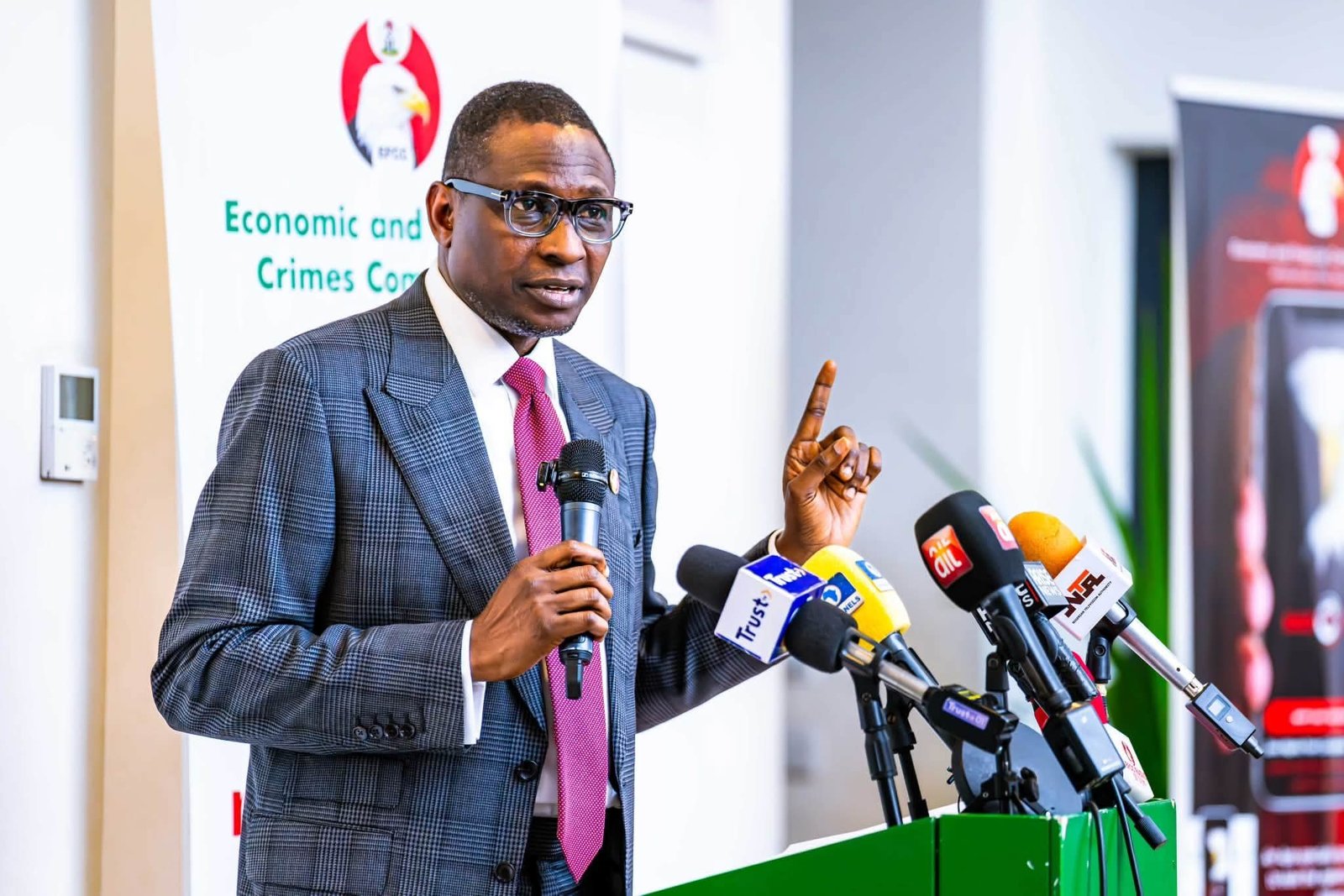
The Economic and Financial Crimes Commission (EFCC) has recorded its highest-ever monetary asset recovery under the leadership of its Executive Chairman, Ola Olukoyede, recovering more than ₦1.23 trillion in 34 months.

Olukoyede disclosed this on Monday, August 31, 2026, while presenting an account of his stewardship and the activities of the anti-graft agency since he assumed office in October 2023.

According to him, the Commission recovered ₦1,233,612,040,411.11, $684,478,457.32, £373,905.78 and €9,343,803.66 during the period under review.
He explained that approximately ₦397.26 billion, representing 33 per cent of the naira recovery, was recovered directly for the Federal Government, while ₦836.34 billion, or 67 per cent, was recovered on behalf of ministries, departments and agencies, state revenue services, companies, individuals and foreign victims.
Olukoyede said the figures showed that “two out of every three naira recovered” were for beneficiaries other than the Federal Government.
On prosecution, the EFCC chairman disclosed that the Commission received 49,673 petitions, investigated 39,615 cases, filed 14,476 cases in court and secured 10,872 convictions between October 2023 and July 2026.
He put the conviction-to-filing ratio at 75.1 per cent, adding that the Commission secured 1,370 convictions from 1,889 filings in the first half of 2026 alone.
He attributed the results to what he described as a prosecutorial approach focused on evidence and courtroom outcomes.
Olukoyede also disclosed that the EFCC recorded 46,288 offences across nine major financial crime categories between 2024 and 2026 year-to-date, with advance fee fraud and cybercrime accounting for nearly two-thirds of the recorded offences.
He noted that recorded offences increased by 24.1 per cent between 2024 and 2025, particularly in procurement fraud, bank fraud, cybercrime and economic-governance offences.
₦661.32bn, $492.37m Released to Beneficiaries
The EFCC boss said the Commission released ₦661.32 billion and $492.37 million to beneficiaries during the period.
He explained that the naira releases included approximately ₦325.35 billion paid directly to individuals and corporate bodies, while ₦335.97 billion went to various MDAs, the Nigerian Revenue Service, state internal revenue services and other beneficiaries.
He further disclosed that federal and state tax recoveries amounted to about ₦288.1 billion, comprising approximately ₦173.2 billion in federal tax recoveries and ₦114.9 billion attributed to state Internal Revenue Services.
An additional ₦257.2 billion in recoveries, he said, was recorded for federal ministries, departments and agencies.
10,053 Assets Forfeited
Beyond monetary recoveries, Olukoyede said the Commission secured the forfeiture of 10,053 tangible assets through interim and final court orders between October 2023 and July 2026.
The assets included 8,198 electronic items, 1,177 real estate properties, 370 automobiles and 251 plots of land, as well as schools, factories, hotels, shops, oil rigs, barges, machinery and aircraft.
He added that the Commission also recorded the forfeiture of 102 tonnes of solid minerals, while proceeds from the disposal of assets under final forfeiture orders amounted to approximately ₦12.07 billion, which was paid to the Federal Government.
EFCC Recovers Funds for Education, Consumer Credit
Olukoyede highlighted the use of recovered proceeds for productive national purposes, recalling the Federal Government’s directive in August 2024 for ₦50 billion each to be allocated to the Nigerian Education Loan Fund (NELFUND) and the Nigerian Consumer Credit Corporation from proceeds of crime.
He said a further ₦50 billion each was allocated to the two institutions in 2026 from EFCC recoveries.
He also disclosed that a forfeited private university, formerly NOK University, had been converted into the Federal University of Applied Sciences, Kachia, Kaduna State, which matriculated 1,909 students in December 2025.
According to him, another high-value private university has also been forfeited to the Federal Government.
920 Specialised Cases, 212 Convictions
The EFCC chairman said the Commission’s specialised enforcement operations covering money laundering, unlicensed bureaux de change, illegal mining, virtual assets and terrorist financing resulted in 920 cases and 212 convictions.
He said money laundering and unlicensed bureau de change cases constituted the largest portion of the portfolio, while the Commission was also responding to emerging risks involving virtual assets and illicit financial flows from the extractive sector.
On foreign exchange-related offences, Olukoyede said the EFCC recorded 234 BDC cases and 73 convictions within the last three years, stressing that the objective was to support a more transparent and compliant retail foreign-exchange market.
Olukoyede also highlighted institutional reforms undertaken during his tenure, including new guidelines on arrest and bail, a review of sting operations and the establishment of the Department of Fraud Risk Assessment and Control, Security Department, Immigration and Visa Section and Cybercrime Rapid Response Centre.
He said new directorates had been established in Ekiti, Anambra and Katsina States, while the Enugu and Ilorin directorates were commissioned during the period.
The EFCC also introduced policies covering gifts and hospitality, conflict of interest and exhibit-room security, while the Internal Affairs Department was renamed and restructured as the Ethics and Integrity Department.
According to Olukoyede, nearly 60 per cent of the Commission’s processes and operations have now been digitalised, with further investment in digital innovation, the EFCC Academy, the 24/7 Cybercrime Rapid Response Centre and EFCC Radio.
He said the past 34 months had been characterised by sustained enforcement, prosecution, asset recovery, restitution, institutional reform and increased collaboration with local and international partners.