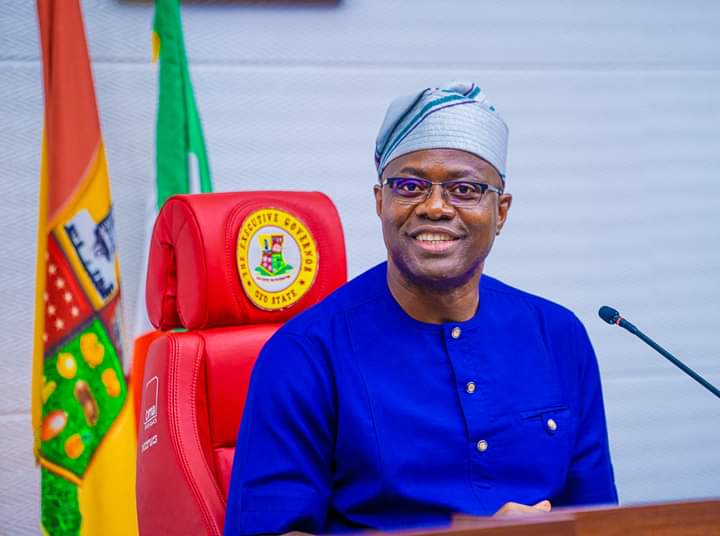
In a few months, the eight-year tenure of Governor Oluseyi Abiodun Makinde as the Executive Governor of Oyo State will come to an end. But while his administration may be approaching its final chapter, the legacies of the governor will continue to speak long after he leaves office.

Makinde occupies a unique place in Oyo State’s political history. His first major political position was that of governor, and against considerable odds, he has used the office to establish a development footprint that will be difficult to erase from the history of the state.

From the beginning, his administration presented human welfare as a central pillar of governance. And, arguably, one of the defining features of the Makinde years has been the attempt to connect humanity with good governance — the idea that government must not merely exist as an institution, but must make a measurable difference in the daily lives of citizens.
The evidence is visible across sectors.
Makinde did not simply concentrate on upgrading some of the existing facilities inherited from previous administrations; his government embarked on the establishment of new infrastructure and institutions while improving critical facilities already on the ground. Roads were opened and reconstructed, transportation corridors improved, public facilities expanded, and economic activities received greater attention.
The objective was not infrastructure for infrastructure’s sake. It was about making movement easier, reducing the burden on businesses, opening up communities and creating an environment in which economic activity could flourish.
That is part of the reason the conversation about Oyo State today is fundamentally different from what it was several years ago.
Yet, as Governor Makinde’s administration approaches its final stretch, an increasingly familiar phenomenon has emerged: the politics of blind criticism.
Criticism is an essential component of democracy. No government should be above scrutiny, and Governor Makinde should not be an exception. Public officials must be questioned about expenditure, policies, borrowing, projects and outcomes.
But there is a significant difference between responsible criticism and criticism driven by political resentment.
Some of Makinde’s most vocal critics are people who have, at different times and in different circumstances, acknowledged the achievements of his administration. That contradiction raises an important question: when does legitimate opposition become an unwillingness to acknowledge progress simply because it is being delivered by a political opponent?
Oyo State belongs to all of us. Its progress should not be measured by who occupies Agodi Government House or which political party controls the state. If a government performs well, the people deserve to benefit from that performance regardless of political affiliation.
Unfortunately, some critics appear to have approached the achievements of the Makinde administration from the opposite direction. Because the projects and successes are not associated with their political camp, they seem determined to diminish them.
That is not constructive opposition. It is political blindness.
Some of the attacks also appear to be rooted in personal ambitions and political calculations. The timing of some of these interventions is particularly revealing. At a period when Governor Makinde enjoys considerable goodwill among sections of the electorate and his political influence has expanded beyond Oyo State, certain individuals have suddenly intensified their attacks.
Perhaps they believe that creating a political war around the governor will weaken his influence.
They may be mistaken.
The attempt to turn Oyo State into a battlefield for the purpose of handing the state over to the All Progressives Congress (APC) is not necessarily a strategy; it could simply become a failed political project if it is not anchored on a credible alternative vision for the people.
The people of Oyo State are not political pawns. They can distinguish between genuine concern for the state and political manoeuvring.
The Masquerade and the Question of Debt
I read with interest the response issued on Friday by the individual described by Dr. Thomas in his intervention as a “masquerade,” particularly his questions concerning the administration’s finances and debt profile.
Questions about borrowing are legitimate. Indeed, they should be encouraged in any democracy.
But the quality of a question matters as much as the question itself.
Instead of merely asking how much the state has borrowed, a more useful line of inquiry would be: What was the money borrowed for? Which projects did it finance? What value has it delivered? What impact has it had on the people of Oyo State?
That is where the real accountability lies.
Debt should not be discussed merely as a political slogan. The important issue is whether borrowed funds were deployed responsibly into productive projects that create value, improve infrastructure, stimulate economic activity and enhance the welfare of citizens.
If a government borrows to build infrastructure that opens up communities, improves transportation, supports commerce and creates long-term economic value, the conversation should go beyond the headline figure.
This is not an argument against scrutiny. On the contrary, it is an argument for deeper scrutiny.
The people deserve to know not only how much was borrowed, but where it went and what it achieved.
Interestingly, the same individual who is now questioning aspects of the administration has, at various times, publicly acknowledged Governor Makinde’s achievements. He is a wealthy and generous individual who was once widely mentioned in political circles as a potential successor to Makinde.
Politics, however, is a game of timing, calculations and choices.
When political expectations do not materialise, personal disappointment can sometimes find expression through political hostility. But governance should not be reduced to the personal ambitions of individuals.
Oyo State is bigger than any individual’s gubernatorial aspiration.
The Social Media Ranter
There is also another category of critics whose interventions on social media and radio deserve closer examination.
Criticism of government is legitimate, but when criticism is built around distorted facts, exaggerated claims and deliberate misrepresentation, it ceases to be intellectually useful.
Using the very legacy projects of the Makinde administration as weapons against the administration, without acknowledging their broader implications, demonstrates a lack of depth in public discourse.
A critic can oppose a project. A critic can question its cost. A critic can demand transparency. But an intellectually honest critic must also acknowledge what the project has achieved.
Oyo State needs more than noise.
It needs informed debate.
It needs people who can challenge government without wishing the state failure. It needs opposition that can say, “This administration has done well here, but it can do better there.”
That is the kind of criticism democracy deserves.
A Model Beyond Oyo
One of the more interesting aspects of the Makinde administration is that its governance model is increasingly attracting attention beyond Oyo State.
Governors and political actors in other parts of Nigeria have taken note of the emphasis on infrastructure, internally generated revenue, economic development, public service delivery and human-centred governance.
Whatever one’s political affiliation may be, it is difficult to deny that Oyo State has undergone significant changes under Makinde.
His political influence has consequently extended beyond the state.
This partly explains why his presidential ambition has generated significant interest across the country. A governor who believes that some of the approaches adopted in Oyo can be replicated at the national level is naturally going to attract attention.
Whether that ambition ultimately succeeds will be decided by the Nigerian people. But there is no doubt that his record in Oyo State has become an important part of the conversation.
Continuity, Not Destruction
As the Makinde administration approaches the end of its constitutional tenure, the most important question before Oyo State should not simply be: Who comes next?
The more important question is: What happens to the gains already recorded?
Governments come and go. Development should continue.
The roads built should be maintained. The institutions established should be strengthened. The economic policies that are working should be improved rather than discarded for political reasons. New administrations should build upon existing successes instead of starting afresh simply to claim ownership.
That is why continuity matters.
The real legacy of a successful administration is not that everything it started remains untouched. It is that subsequent administrations inherit a stronger foundation and take the state even further.
Oyo Has Not Always Had It This Good
Before the critics begin rewriting history, it is important to remind them that Oyo State has passed through different administrations, each with its own strengths and weaknesses.
But there is a strong argument to be made that the state has witnessed an unusual combination of infrastructure expansion, economic reforms, public-sector interventions and investment under Makinde.
Local businesses have benefited from improved infrastructure and economic activity. Investors have increasingly looked towards the state. Communities that were previously difficult to access have received attention. The relationship between government and the people has, in many respects, become more visible.
None of this means Governor Makinde is perfect.
No government is.
There will always be shortcomings. There will always be projects that deserve questioning. There will always be citizens who believe government can do better.
But acknowledging shortcomings should not require denying achievements.
And acknowledging achievements should not mean abandoning scrutiny.
The danger before Oyo State is therefore not criticism itself. The danger is blind criticism — criticism so consumed by political resentment that it becomes incapable of recognising genuine progress.
Governor Seyi Makinde will eventually leave office.
The political arguments surrounding his administration will eventually fade.
But the roads will remain.
The institutions will remain.
The infrastructure will remain.
The businesses that benefited from an improved environment will remain.
And, most importantly, the people who experienced the changes will remain.
That is why the final verdict on Makinde’s eight years will not ultimately be written by his critics or his supporters.
The people of Oyo State, and the physical and institutional transformation they inherit, will write it.
And when the history of this period is eventually written, political opponents may disagree with Makinde’s methods, policies or ambitions. But they will find it considerably harder to erase the footprint his administration has left on Oyo State.
Gbenga Ajani writes from Ijokodo Ibadan